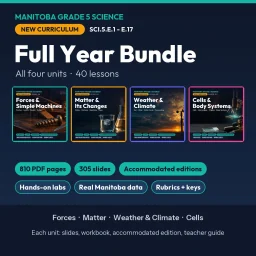
NEW Manitoba Grade 5 Science Forces & Machines | 10 Lessons, Labs & Assessments
Teach the force outcomes of Manitoba's renewed Grade 5 Science curriculum with hands-on labs and real Manitoba data. Ten inquiry lessons cover pushes, pulls and twists, how forces change motion, friction (helpful and harmful), all six simple machines, and why friction makes every machine less efficient. The unit is built around one driving question, "How can forces and simple machines make work easier, and what keeps any machine from being perfect?", and ends with a design report that answers it. Manitoba Education states that the renewed K to 10 Science curriculum is finalized and posted for full implementation in the 2026/27 school year.
10 lessons, 76 slides, 77-page student workbook
View on TpT (opens in a new tab)
Sold on Teachers Pay Teachers. The price, checkout and download are on the listing.
Price and checkout on TpT
What you get on TpT
- 77-page student workbook
- 93-page accommodated edition
- 76 editable teaching slides
- Answer keys
- Rubric
- START HERE guide
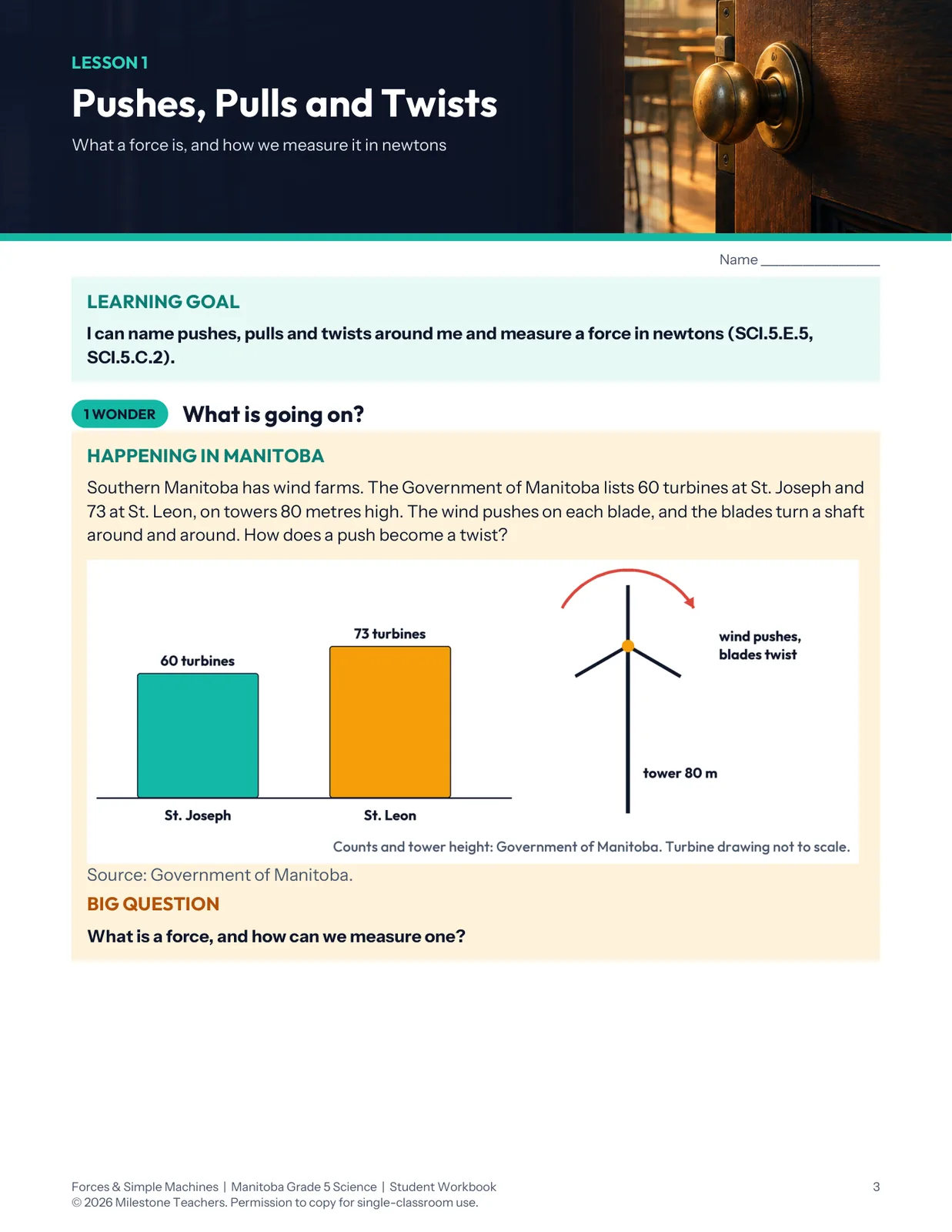
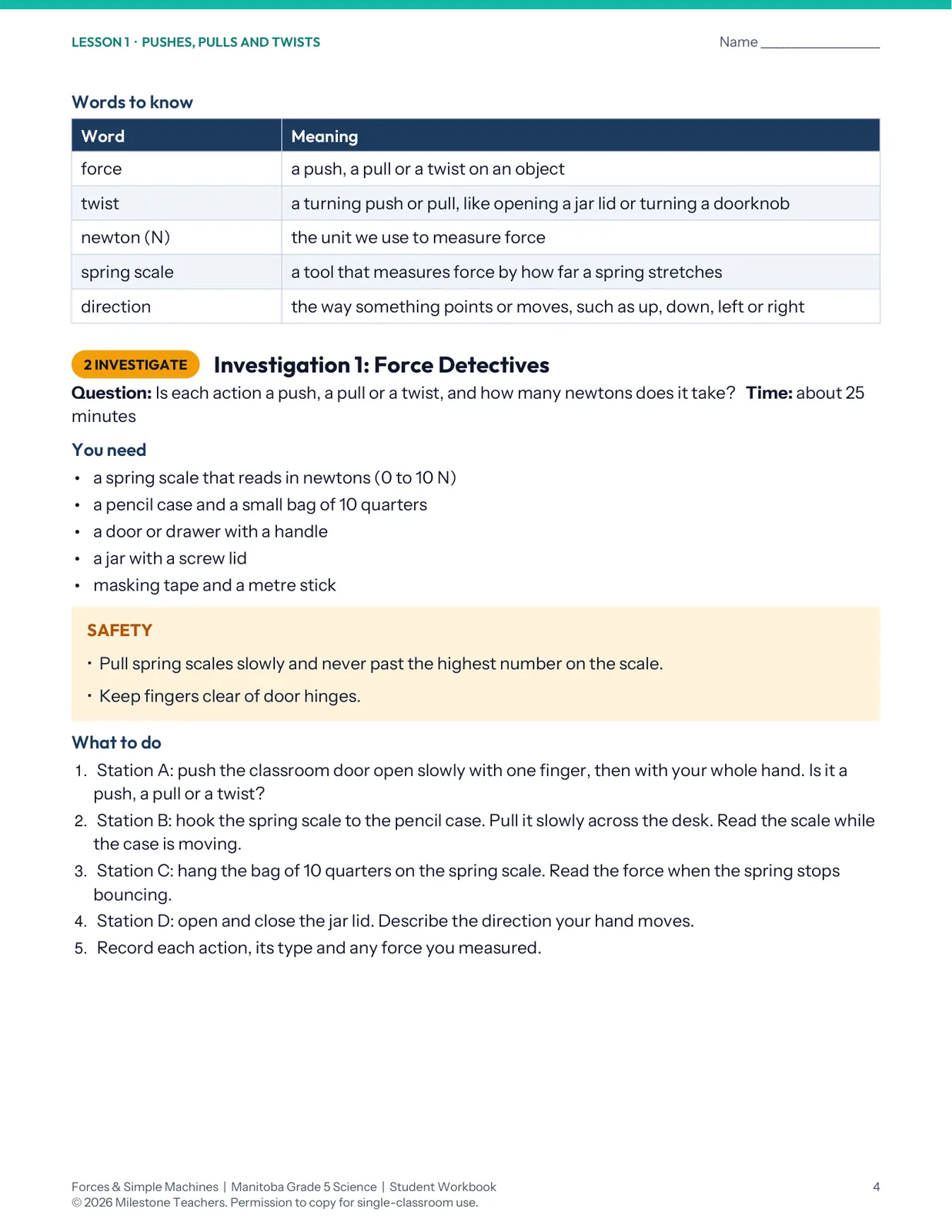
Look inside
Before you buy
- It covers the force outcomes only and has no classroom interactive; spring scales vary, so keys for students' own measurements give typical results.
- Written by an Ontario Certified Teacher; not reviewed or endorsed by Manitoba Education and Early Childhood Learning.
- The licence included with each resource governs classroom use and sharing.
Part of this bundle
- NEW Manitoba Grade 5 Science Full Year Bundle | 4 Units, 40 Lessons, Labs
- NEW Manitoba Grade 5/6 Split Class Science Full Year Bundle | Renewed Curriculum
Continue your planning
- Manitoba Grade 5 Science Full Year Bundle
Plan the whole Grade 5 year with the four-unit bundle.
- Manitoba Grade 5 Matter & Its Changes Unit
Teach Matter & Its Changes (SCI.5.E.1 to E.4) as a separate unit.
- Manitoba Grade 5 Weather & Climate Unit
Teach Weather & Climate (SCI.5.E.9 to E.12) as a separate unit.
- Manitoba Grade 5 Cells & Body Systems Unit
Teach Cells & Body Systems (SCI.5.E.13 to E.17) as a separate unit.