Guide · Grades K-8
What to Put in a Sub Binder (K-8): A Teacher's Checklist
A sub binder is the one place a guest teacher can find everything needed to run your day safely: who the students are, when things happen, how your room works, what to do in an emergency, what to teach, and how to tell you what happened. Eight tabbed sections cover it. Here is what goes behind each tab, what to keep out of it, and a one-page checklist you can print.
Print the one-page checklist · See the editable Sub Binder from Milestone Teachers
The eight sections of a sub binder
1. Start Here
The page a guest teacher reads first, and the one to update the night before a planned absence.
- A short welcome note: your name, your room, and how to reach the office.
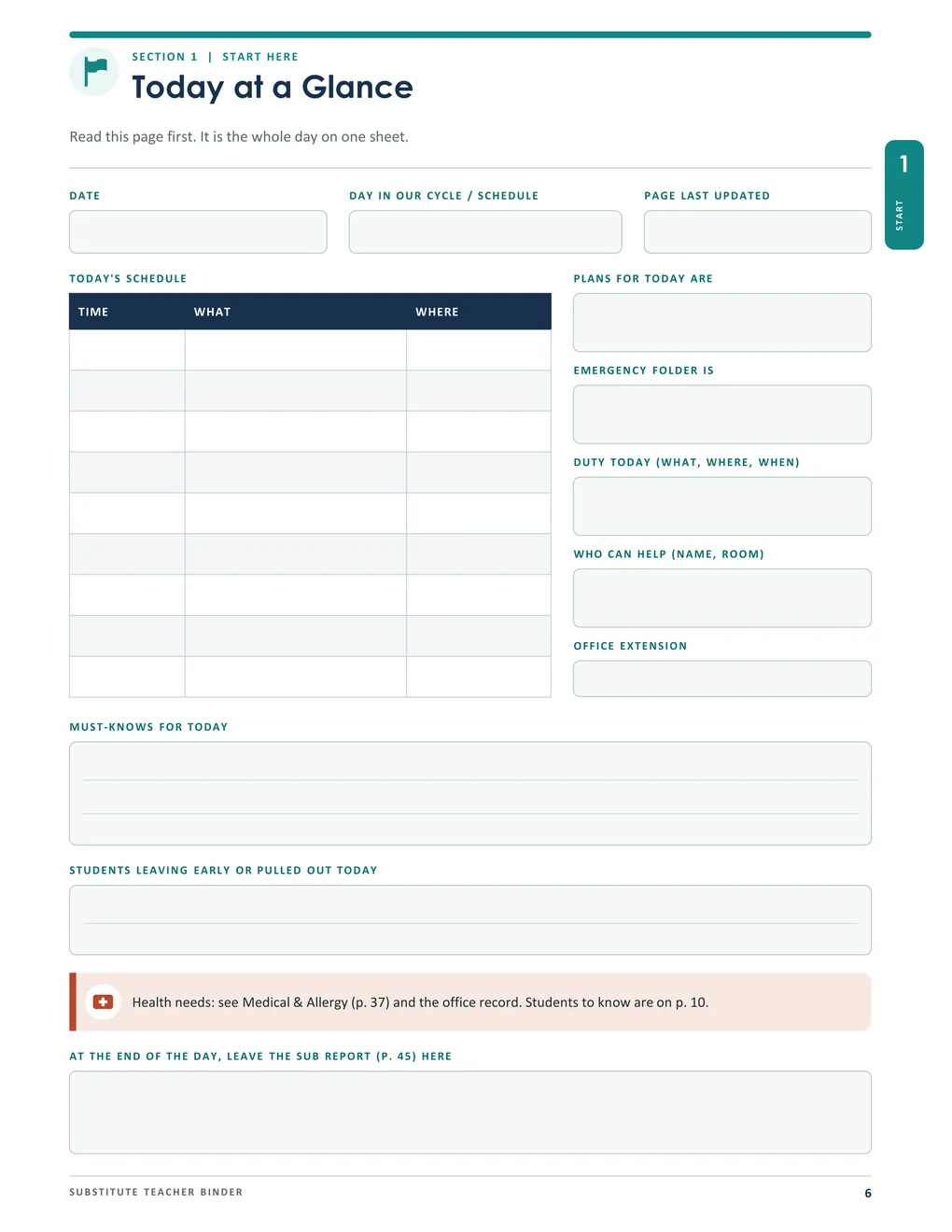
- Today at a Glance: the day's schedule, where today's plans and the emergency folder are, any duty, who can help (name and room) and the office extension.
- Students leaving early or pulled out today.
- An arrival checklist for the first 15 minutes: sign in, find the plans, find the two nearest exits and the evacuation class list, learn the attention signal, and be at the door to greet students.
Tip: If the guest teacher reads only one page, it will be this one. Keep it on top.
Binder pages: Welcome Letter, Today at a Glance, Your First 15 Minutes.
2. Our Class
Who the students are and where they sit.
- A class snapshot: grade, number of students, and what usually works with this group.
- Students to Know: first names or initials, what helps today, and where the student's plan is kept.
- Two or three reliable helpers and the job each one can do.
- The class list you would take outside in an evacuation.
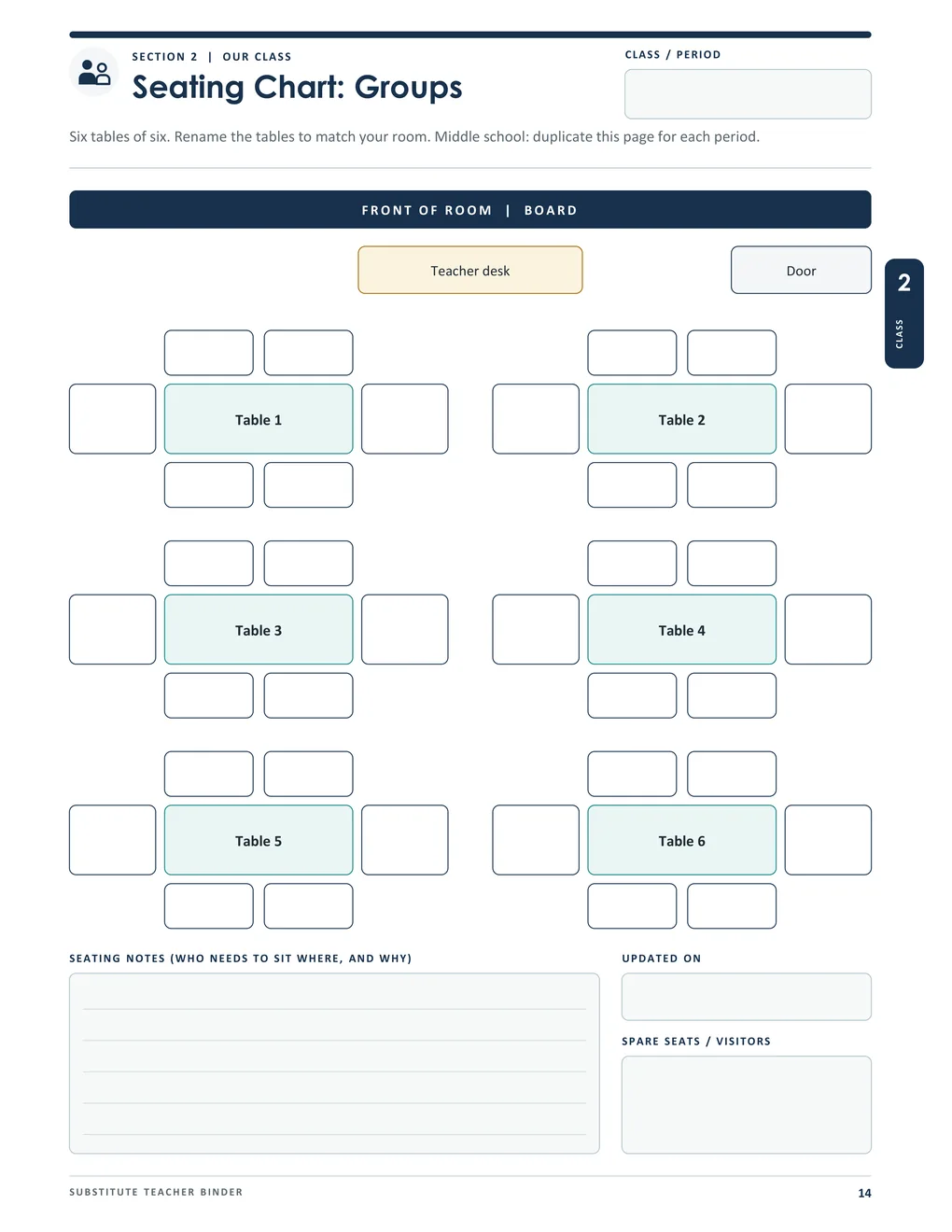
- A seating chart that matches the room today: rows, groups or a U-shape.
Tip: Guest teachers call names from the seating chart. Update it after every change.
Binder pages: Class Snapshot, Students to Know, Helpers & Class Jobs, Class List, Seating Charts (rows, groups, U-shape, blank grid).
3. Schedules
When everything happens, including the parts that are not on the timetable.
- A homeroom day schedule with specials, recess and lunch, or a period schedule for middle school and rotary.
- Bell times, and any duty with its place and time.
- Who leaves the room and when: support pull-outs, lessons and early pick-ups.
Tip: Write times as the bell rings them, not as the timetable rounds them.
Binder pages: Homeroom Day Schedule, Period Schedule (Middle School / Rotary), Bell Times & Duties, Who Leaves the Room & When.
4. Routines & Room
How your room runs, in the order the day happens.
- Start of the day: entry, attendance and the morning routine.
- During the day: the attention signal, transitions, bathroom and hall pass, phones and personal devices.
- End of the day: pack-up, dismissal, buses and pick-up.
- A room map and where things are kept.
- Technology: how to turn on the display, where devices are stored, and where the school keeps guest sign-in information.
- Materials for today.
Tip: Name the signal your students already know. A new signal on a sub day rarely works.
Binder pages: Start of the Day, During the Day, End of the Day, Room Map, Where Things Are, Technology, Materials for Today.
5. Behavior & Calm
Your expectations, and what to do in the moments that go sideways.
- Your expectations and how you usually recognize good choices.
- Short plans for common moments: a student won't start work, two students are in conflict, a student is upset, sick or hurt, or leaves without permission, a device is misused, the class is too loud to go on.
- Where the calm-down space is, the signs a student needs a break, and who to call for support.
Tip: Write what your class actually does, in the words you use with them. Never leave the class unsupervised; call for help to come to you.
Binder pages: Expectations & Positive System, What to Do If..., Calm & Support.
6. Safety
Emergency procedures and the people to call.
- Fire and evacuation: the exit route, the meeting spot, and which class list to take.
- Lockdown and shelter procedures.
- Medical and allergy: where health action plans, the first-aid kit and emergency medication are kept, with initials only.
- Key contacts: the office, your neighbor teacher and room, the administrator on call, first aid.
Tip: Copy your school's posted procedures word for word. Terms and steps differ by school and district.
Binder pages: Fire & Evacuation, Lockdown, Secure & Shelter, Medical & Allergy, Key Contacts.
7. Lesson Plans
What to teach today, and what to do when there is no plan.
- Today's plan, block by block (elementary) or period by period (middle school), with where the materials and copies are.
- Where your emergency plans are kept, how they are labeled, and the order to use them.
- An early-finisher menu students can choose from without asking.
Tip: Keep three emergency plans ready with copies and answer keys, and refill the one that gets used.
Binder pages: Full-Day Plan, Period Plan, Emergency Day Plan, Early-Finisher Menu.
8. Sub Report
How the guest teacher tells you what happened.
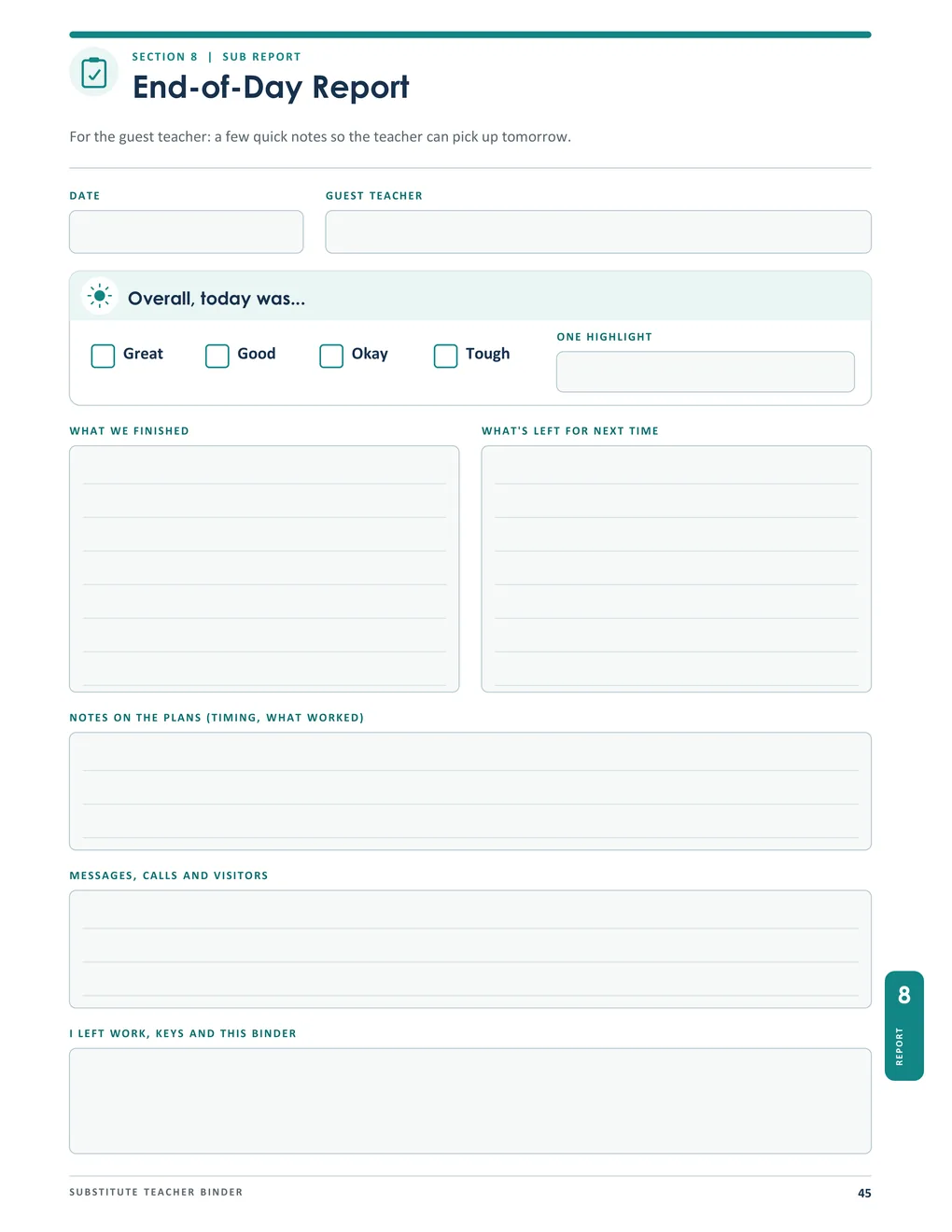
- An end-of-day report: what was finished, what is left, notes on the plans, messages and visitors, and where work and keys were left.
- For middle school, a period-by-period report, including who was absent or late.
- Attendance and behavior notes: what happened, when, what the guest teacher did, and what needs follow-up.
Tip: Ask for facts, not verdicts. Short, factual notes are the ones you can act on the next morning.
Binder pages: End-of-Day Report, Period-by-Period Report, Attendance & Behavior Notes, Student Notes.
Privacy: what to keep out of the binder
A sub binder sits in a classroom where students, visitors and other adults can open it. Write what a guest teacher needs for today, and point to the official record for everything else.
Do
- Use first names or initials on student pages.
- Write where health action plans and emergency medication are kept, and point to the office or nurse record.
- Write where the school keeps guest sign-in information, and who to ask for it.
- Copy safety procedures from your school's posted plan.
- Keep the binder in one place the office and your neighbor teacher know.
Don't
- Never write passwords, login details or door codes in the binder.
- Don't copy diagnoses, support plans or health details into it. Write what helps today instead.
- Don't write family, custody or legal details. The office keeps the authorized pick-up list.
- Don't add student photos unless your school's policy allows it.
- Don't leave student pages open where students can read them.
Elementary vs. middle school
The eight sections stay the same from kindergarten to Grade 8. What changes is how many classes the guest teacher meets in a day.
| Part | Elementary (homeroom) | Middle school (periods) |
|---|---|---|
| Schedule | One homeroom day with specials, recess and lunch. | A period (rotary) schedule with bell times and room changes. |
| Class list and seating | One class list and one seating chart. | A class list and a seating chart for each period. |
| Lesson plans | Block by block for one class. | One plan per period, grouped by class. |
| Routines to spell out | Bathroom, recess, lunch, bus lines and pick-up. | Hall passes, phone rules and class changes. |
| Sub report | One end-of-day report. | A period-by-period report, including who was absent or late. |
Set up the must-haves in 20 minutes
You don't need the whole binder before your first absence. These are the must-haves: enough for a guest teacher to run a safe day. Fill in the rest over your first two weeks.
- 2 min: Label the binder. Write "Sub Binder" and your room number on the spine, and add eight tabs in the order above.
- 6 min: Fill in Today at a Glance. The schedule, where the plans and emergency folder are, any duty, who can help and the office extension.
- 4 min: Add key contacts. The office, your neighbor teacher and room, the administrator on call and first aid.
- 4 min: Copy fire and evacuation. The exit route and meeting spot from your school's posted plan, and where the evacuation class list is.
- 2 min: Point to health plans. Where health action plans and emergency medication are kept. Initials only.
- 2 min: Tell the office. Show the office and your neighbor teacher where the binder lives.
Over the next two weeks, add the class list, a seating chart, your routines, the behavior pages and three emergency plans. After that, update one page whenever something changes.
Sub Binder Checklist (K-8)
Tick each item when it is in the binder. Items marked with a star are the 20-minute must-haves.
1 Start Here
- Welcome note with your name, room and office contact
- ★ Today at a Glance, updated for the day
- First-15-minutes arrival checklist
2 Our Class
- Class snapshot
- Students to Know (first names or initials)
- Class list for evacuation
- Current seating chart (one per period in middle school)
3 Schedules
- Day or period schedule with bell times
- Duties: where and when
- Who leaves the room and when
4 Routines & Room
- Start, during and end of the day
- Attention signal
- Room map and where things are
- Guest sign-in location (no passwords)
5 Behavior & Calm
- Expectations and positive system
- What to do if...
- Calm-down space and who to call
6 Safety
- ★ Fire and evacuation, copied from the posted plan
- Lockdown and shelter procedures
- ★ Where health plans and medication are kept
- ★ Key contacts
7 Lesson Plans
- Today's plan with materials
- Three emergency plans with copies and keys
- Early-finisher menu
8 Sub Report
- End-of-day report
- Period-by-period report (middle school)
- Attendance and behavior notes
Keep it current
- Update the seating chart after every change
- Refill the emergency plan that was used
- Re-check contacts, bus lists and pull-out times each term
Ready-made options
Build it yourself from the checklist, or start from ours. The editable Sub Binder has the eight sections above as fill-in pages.
- Sub Binder, Editable Substitute Teacher Binder (K-8). 52 pages in the eight tabbed sections on this page, as an editable PowerPoint file and a printable PDF, with a 20-minute must-haves page, four seating charts and a Teacher Toolkit. It is a set of templates you fill in: it does not include your class information, your school's procedures or lesson plans. List price USD $7.95 from Milestone Teachers. The product page confirms the current checkout price.
- Middle School Emergency Sub Plans, Grades 6-8: 5 Full No-Prep Days. Ready-to-teach days for the Lesson Plans tab.
- Middle School Emergency Sub Plans, Grades 6-8, Volume 2: 5 More No-Prep Days. Five more no-prep days for Grades 6-8.
- Middle School Emergency Sub Plans Bundle, Volumes 1 and 2: 10 No-Prep Days. Both volumes together.
- Emergency sub plans: free K-8 activities. Free activities by grade band and a one-page handoff you can adapt.
What a sub binder can't do
A binder does not replace your school's own procedures or records: the Safety pages hold what the school has posted, and health and family details stay in the office. It also is not a lesson plan. The Lesson Plans tab tells a guest teacher where the plans are; the plans themselves still have to be written or bought.
Related: Emergency sub plans and free K-8 activities · High school sub plans: what a no-prep day needs · All teacher guides