Free interactive · Manitoba Grade 6 Science · Forces and Energy
Circuits & Buoyancy Lab: light the bulb, then float the barge
Two labs in one for the Forces and Energy outcomes. Students build a battery circuit with a bulb, an LED, a buzzer or a motor and follow where the energy goes, test which of 10 materials conduct, then drop objects into a water tank and load a foil barge with washers until it sinks. It is free, runs in the browser, and needs no login or email.
Free · No login · No email · Nothing saved or sent
Milestone Teachers - created by an Ontario Certified Teacher · Last reviewed
Open Circuits & Buoyancy Lab (free, full screen) · Manitoba's renewed Grade 6 Science: the teacher's guide
What it is
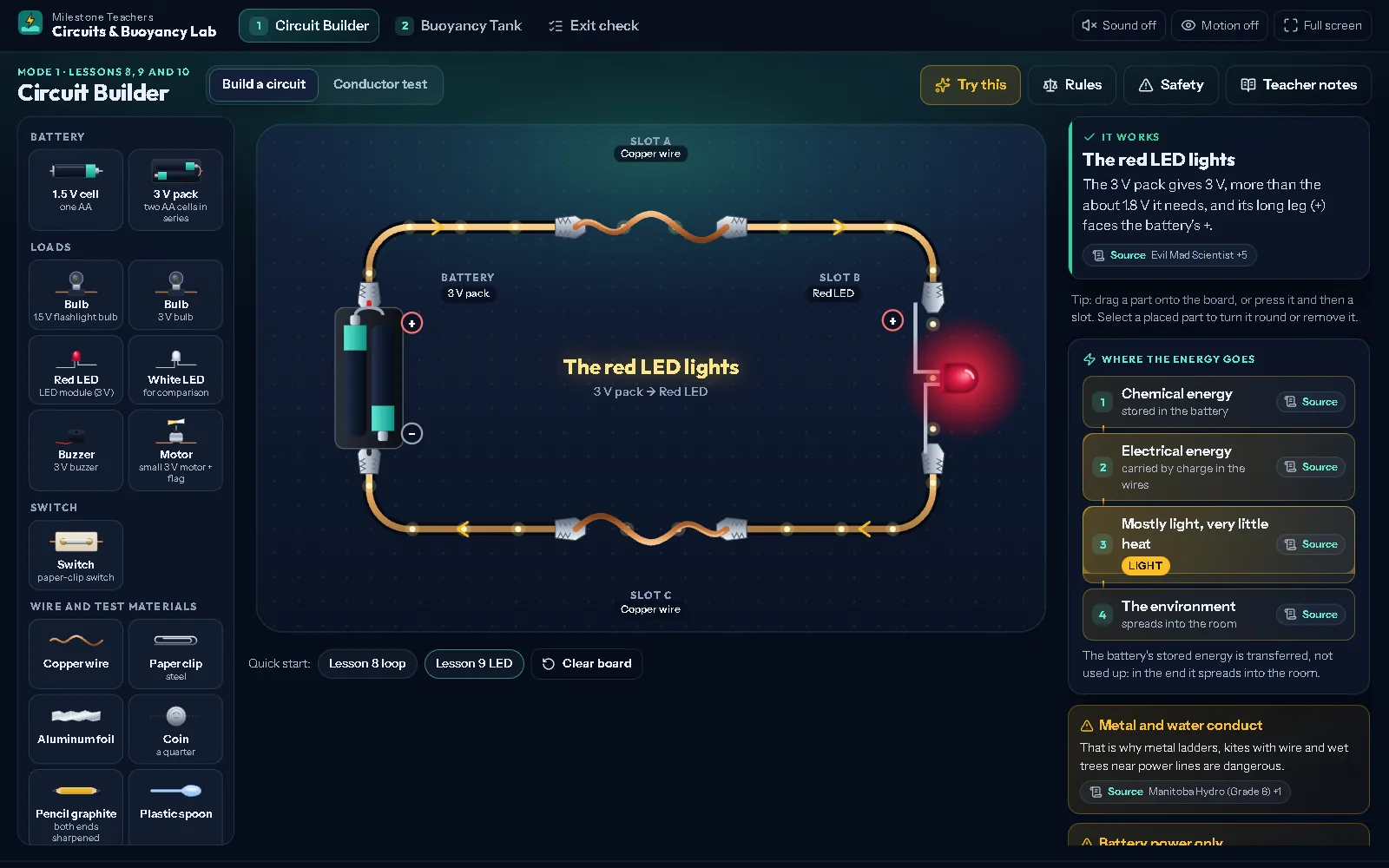
- Circuit Builder. Drag parts, or use the keyboard, to build one loop: a 1.5 V cell or a 3 V pack, a paper-clip switch and one load (a 1.5 V or 3 V bulb, a red or white LED, a buzzer or a motor). When the load works, the charge flow and an energy chain show where the battery's energy goes.
- Conductor test. Which materials let the bulb light? Ten to try, from copper wire, a paper clip and a coin to pencil graphite, a rubber eraser and cotton string, following the unit's Investigation 8.
- Safety where it matters. Short circuits, water, rubber boots near a fallen power line and button batteries: the safety cards quote Manitoba Hydro and Health Canada.
- Buoyancy Tank. Six objects, from a block of ice to an AA battery and a golf ball, with masses and sizes quoted from sources or calculated from them. Drop one in, see the water it pushes aside drawn to scale, and compare its density with water; for a sinking object, read its weight in air, the buoyant force and its weight in water.
- Cargo Barge. The unit's Lesson 5 challenge on screen: a hull folded from one 20 cm square of foil. Predict how many 5.2 g washers it holds, then load it one at a time until it sinks.
- Teacher notes, Try this and an exit check. Where each mode fits in the unit, questions to ask, misconceptions to surface, 11 Try this investigations and an 11-question exit check. The teacher key stays hidden until you choose to show it, and prints separately from the student copy.
- Free. No login, no email, no sign-up.
- Runs in any current browser, with a mouse, a touch screen or the keyboard. The app makes no network requests while it runs.
- Nothing a student does is saved or sent.
How to use it in class
- Project it and build the first loop together. Open the lab on the classroom display and build the Lesson 8 loop as a class: the 1.5 V cell, the 1.5 V bulb and two copper wires. It works with a mouse, a touch screen or the keyboard.
- Ask for a prediction before every change. "Will it light? Why?" Then make the change: swap the load on the 3 V pack, turn the LED round, open the switch, or put a test material in the gap.
- Move to the tank. Ask float or sink before each drop and keep a class tally. For an object that sinks, the three force numbers are the unit's Investigation 4.
- Finish with the barge or the exit check. Groups design a barge on paper, test their dimensions here, then compare with their real foil boat. Or print the exit check for the class; the teacher key prints from its own button.
Curriculum link
Built for the Forces and Energy outcomes of Manitoba's renewed Grade 6 Science curriculum.
- SCI.6.E.3: The principles of buoyancy.
Demonstrate a conceptual understanding of the principles of buoyancy.
Buoyancy Tank and Cargo Barge: density compared with water, the water pushed aside, and the forces on an object that sinks. - SCI.6.E.6: Energy in battery-powered circuits.
Demonstrate the understanding that in battery-powered circuits, as electricity flows, energy is transferred from the battery to components in the circuit and ultimately to the environment.
Circuit Builder: a complete loop, conductors and insulators, charge flow, and the energy chain from the battery to each load and out to the room. - SCI.6.E.7: Electrical safety.
Demonstrate an understanding of safety precautions associated with electricity.
The safety cards: short circuits, water, rubber and fallen power lines, and button batteries.
Contains information from the Government of Manitoba, licensed under the OpenMB Information and Data Use License (Manitoba.ca/OpenMB). OpenMB licence.
Manitoba's renewed Grade 6 Science: the teacher's guide
Units for this year
The Forces & Energy unit uses Circuits & Buoyancy Lab in Lessons 4, 5, 8, 9 and 10 and includes an offline copy of it.
- Manitoba Grade 6 Science NEW Curriculum Forces & Energy | Buoyancy & Circuits. SCI.6.E.1 to E.7: gravity and the forces that oppose it, buoyancy and density, stored energy and transfer, battery circuits and electrical safety. 10 lessons: 80 editable slides and 211 PDF pages (a 73-page student workbook, a 97-page accommodated edition, a 40-page teacher guide with answer keys and a 1-page START HERE guide), plus structured offline reading versions and the Circuits & Buoyancy Lab. Teacher keys and speaker notes are separate from student reading files. See the current price and currency on the product page before purchasing.
Honest limits
- The circuit model is one series loop with one load at a time. It shows what happens, not how much current flows.
- LED voltages are typical values and real LEDs vary, so the lab says a white LED on the 3 V pack may glow dimly, or not at all.
- The buzzer and motor follow one real datasheet each. Kits vary: check your own parts' ratings.
- Water is treated as exactly 1 g/cm³. The barge ignores tipping, leaks and uneven loading, so a real foil boat usually carries fewer washers than predicted.
- Independent of Manitoba Education and Early Childhood Learning and of Manitoba Hydro: not a resource of either.
Credits
- Circuit rules: The Physics Classroom; Manitoba Hydro's Grade 6 resource; Evil Mad Scientist Laboratories and SparkFun Electronics (LEDs); Same Sky (buzzer datasheet); Mabuchi Motor (motor table); London Grid for Learning; Science Buddies, ingridscience.ca and TeachEngineering (conductors); the Royal Canadian Mint (coin).
- Energy and safety: U.S. Energy Information Administration; Natural Resources Canada; Manitoba Hydro; Health Canada.
- Buoyancy: USGS Water Science School; NASA Glenn Research Center; The Physics Classroom; HyperPhysics (Georgia State University); ITTF and The R&A (ball sizes); Energizer (AA battery datasheet); Transport Canada.
- Art, software and type: Original illustrations made for Milestone Teachers, no photographs of real people; the parts, circuit board, tank and barge are drawn in code. Lucide icons (ISC licence); Outfit and Instrument Sans (SIL Open Font License 1.1).
- Made by: Milestone Teachers. Created by an Ontario Certified Teacher.
Sources
Checked against the sources below on 29 September 2026.
- The Physics Classroom: Requirements of a Circuit
- Manitoba Hydro: Electricity and natural gas: the good, the bad and the scary (Grade 6 resource)
- Manitoba Hydro: Our equipment and facilities (power line safety)
- Evil Mad Scientist Laboratories: Basics: Picking Resistors for LEDs
- Health Canada: Battery safety
- U.S. Geological Survey Water Science School: Water Density
- NASA Glenn Research Center: Buoyancy: Archimedes Principle
- Manitoba Education and Early Childhood Learning: Science: Grade 6 (English Program)
These are the main sources. The app itself names a source beside every rule and number, and lists all 35 under "All sources".