Free interactive · Manitoba Grade 6 Science · Heredity, Diversity and Fossils
Classify & Fossils Lab: build a key, then read the rocks
Students sort nine real Manitoba organisms, from the polar bear to Bruce the mosasaur, into a dichotomous key that works and test it on a classmate. Then they read Manitoba's past in its rock layers: which fossil is oldest, how a fossil forms, and what Tyndall Stone shows. It is free, runs in the browser, and needs no login or email.
Free · No login · No email · Saved on this device only
Milestone Teachers - created by an Ontario Certified Teacher · Last reviewed
Open Classify & Fossils Lab (free, full screen) · Manitoba's renewed Grade 6 Science: the teacher's guide
What it is
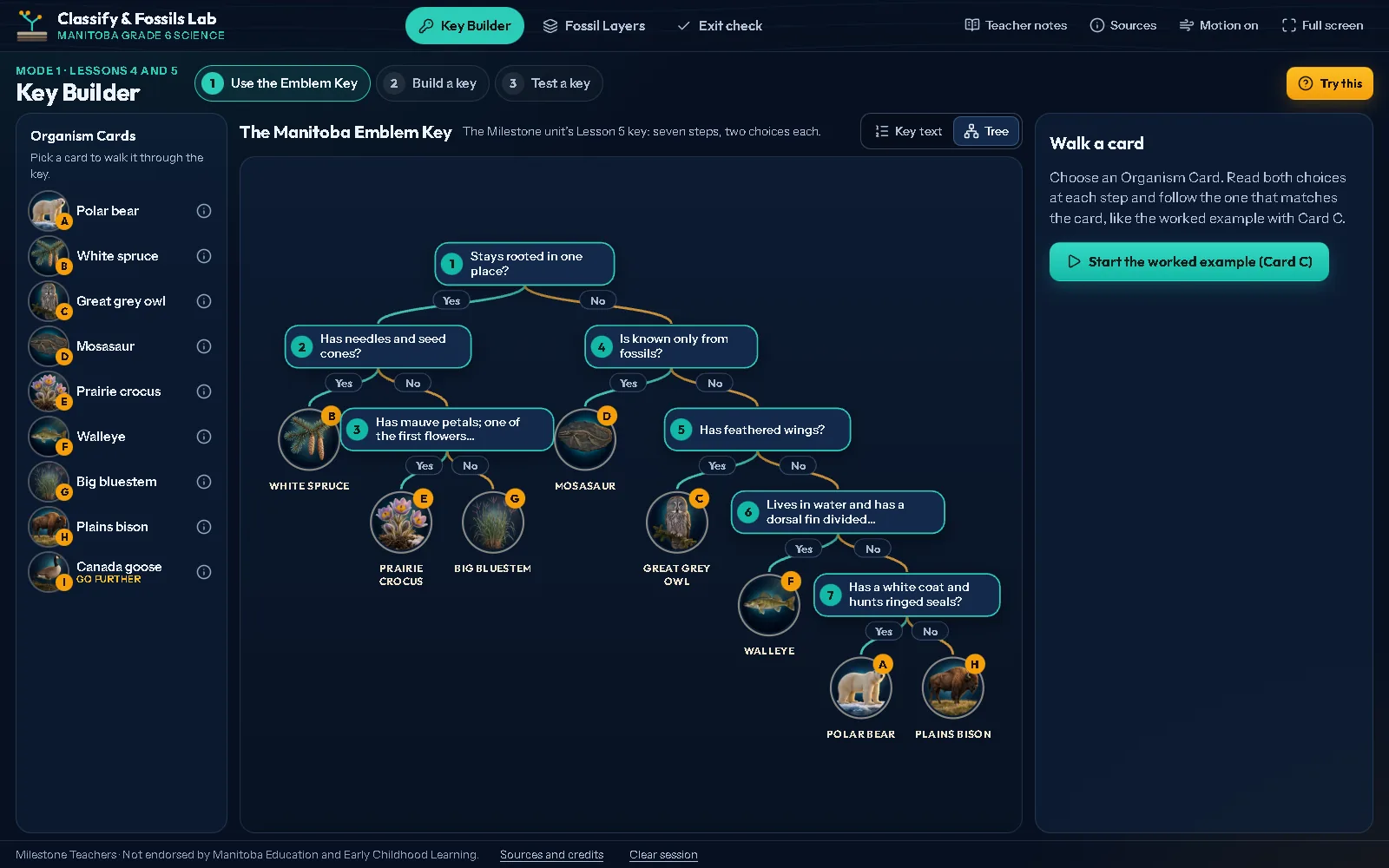
- Use the Emblem Key. The unit's Lesson 5 key for Manitoba's emblems, as text or as a tree. Walk any of the nine Organism Cards through it step by step; Card I, the Canada goose, shows where the key breaks.
- Build a key. Choose yes-or-no questions from a bank of 13 sourced traits, or write your own. The tree grows as students sort, the lab checks bank questions against the cards, and the finished key prints in the unit's 1a/1b format with a code a classmate can enter.
- Test a key. Run mystery cards through the class's own key, the Emblem Key or a classmate's key code, and find the step that needs rewriting.
- Fossil Layers. Read four rock layers in 2-D or dig through them in 3-D, lay layers down in any order, and step through how a fossil forms in six steps, following the unit's Lesson 9 model.
- Tyndall Stone and deep time. Sort the fossils in Tyndall Stone, the fossil-rich limestone on the Manitoba Legislative Building, into body and trace fossils. Then place the first trilobites, the Tyndall seafloor, Bruce the mosasaur and the ice sheet of 18,000 years ago on a deep-time line to scale.
- Teacher notes and an exit check. Where each part fits in the unit, 10 misconceptions to surface, Try this prompts and an 8-question exit check. The teacher key stays hidden on screen and prints separately from the student copy.
- Free. No login, no email, no sign-up.
- Runs in any current browser. The app makes no network requests while it runs.
- Keys and answers are saved in this browser on this device only, and never sent. Clear session, at the bottom of every screen, removes them.
How to use it in class
- Model the worked example. Project the Emblem Key and walk Card C, the great grey owl, together. Then let pairs walk the other cards. The lab works with a mouse or entirely by keyboard.
- Go further with Card I. Walk the Canada goose. It keys out as the owl: ask what new step would separate the two.
- Build, then swap. Pairs build their own key, copy its key code, and test a partner's key on mystery cards, as in the unit's Performance Task.
- Read the rocks. In Fossil Layers, order the four fossils from oldest to youngest, then step through how a fossil forms. Finish with exit check items 1, 5 and 6 (the lab's own 30-minute plan).
Curriculum link
Built for the diversity and fossil outcomes of Manitoba's renewed Grade 6 Science curriculum.
- SCI.6.E.14: Classifying the variety of organisms.
Demonstrate the understanding that there is a wide variety of organisms in the world, which are systematically categorized by scientists.
Key Builder: physical traits, the classification on every Organism Card, and a dichotomous key built, tested and revised. - SCI.6.E.15: Fossils as evidence of change.
Demonstrate the understanding that fossils provide evidence of how organisms have changed over time.
Fossil Layers: relative age from the order of the layers, how a fossil forms, Tyndall Stone and Bruce the mosasaur on a deep-time line.
Contains information from the Government of Manitoba, licensed under the OpenMB Information and Data Use License (Manitoba.ca/OpenMB). OpenMB licence.
Manitoba's renewed Grade 6 Science: the teacher's guide
Units for this year
The Heredity, Diversity & Fossils unit uses Classify & Fossils Lab in Lessons 4, 5, 9 and 10 and the Performance Task and includes an offline copy of it.
- Manitoba Grade 6 Science NEW Curriculum | Heredity, Diversity & Fossils Unit. SCI.6.E.12 to E.17: offspring and parents, traits, classification and dichotomous keys, fossils, species and hybrids. 10 lessons: 80 slides and 208 PDF pages (a 74-page student workbook, a 94-page accommodated edition, a 39-page teacher guide with answer key and a 1-page START HERE guide), plus an offline copy of the Classify & Fossils Lab. See the current price and currency on the product page before purchasing.
Honest limits
- Questions a student types in are not checked by the lab, only whether every card ends at its own name. Check those traits against the cards together.
- The rock-layer model uses stylized shapes, not real species, as the unit's Lesson 9 model does. Not to scale.
- The Tyndall Stone and seaway pictures are illustrations made for the unit, not photographs.
- Classifications are from ITIS records saved on 29 September 2026. Taxonomy changes; ITIS may list different names later.
- Ages are the museums' rounded figures. Independent of Manitoba Education and Early Childhood Learning: not one of its resources.
Credits
- Organism Cards: Cards A to H are the unit's Lesson 5 cards. Traits come from the Government of Manitoba's emblems document, Hinterland Who's Who, Tree Canada, Fisheries and Oceans Canada, Parks Canada and the Natural History Museum (London).
- Classifications: ITIS, the Integrated Taxonomic Information System (records saved 29 September 2026).
- Fossils: The Manitoba Museum, the University of Saskatchewan Museum of Natural Sciences, the Canadian Fossil Discovery Centre, the Natural History Museum (London) and the U.S. National Park Service.
- Art, software and type: Organism plates and the prairie scene are original illustrations made for Milestone Teachers, with no photographs and no people; the rock layers, fossil shapes and key tree are drawn in code. three.js (MIT licence), Lucide icons (ISC licence), Outfit and Instrument Sans (SIL Open Font License 1.1).
- Made by: Milestone Teachers. Created by an Ontario Certified Teacher.
Sources
Checked against the sources below on 29 September 2026.
- Government of Manitoba: Official Emblems of Manitoba
- Natural History Museum (London): What is taxonomy?
- Natural History Museum (London): What is a fossil?
- U.S. National Park Service: Geologic Principles: Superposition and Original Horizontality
- The Manitoba Museum: The fossils surround us
- Canadian Fossil Discovery Centre: Meet Bruce
- Hinterland Who's Who: Polar Bear
- Manitoba Education and Early Childhood Learning: Science: Grade 6 (English Program)
These are the main sources. Every fact in the app names its source, and its Sources panel lists all 26, including the nine ITIS records.