Make-ten addition: help pupils move beyond counting every counter
When a pupil solves 8 + 5 by touching and counting every counter from one, the answer may be correct. The next teaching decision is not to rush them into a new trick. It is to make the structure of ten visible and give them a way to describe it.
This short routine uses 8 + 5 because it makes the useful relationship concrete: 8 needs 2 to fill a ten-frame, leaving 3. So 8 + 5 can be composed as 10 + 3 = 13.
Try the free Fact Strategy Studio for an untimed, no-login visual model, rehearsal, and fresh check.

First, notice which counting action you are seeing
These three actions can look similar if we only record an answer.
Count-all: the pupil starts at 1 and counts all 13 objects across both groups. This can be a sensible representation-based method, but it does not yet use the known total of eight as a starting point.
Count-on: the pupil holds 8 and says “9, 10, 11, 12, 13.” This is more efficient because 8 is treated as an amount already known. It still does not necessarily show the ten structure.
Make-ten: the pupil sees that 8 needs 2, splits 5 into 2 and 3, and composes 10 + 3. The important evidence is not only “13.” Listen for or look for the relationship between 8, 2, 10, and 3.
None of these labels should be used as a fixed description of a pupil. They describe what is visible in one moment so the teacher can choose a useful next prompt.
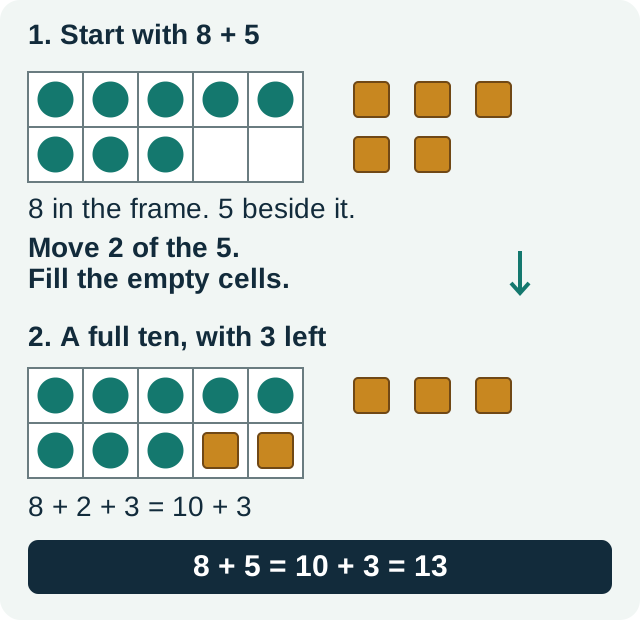
A five-minute 8 + 5 teaching routine
Place eight counters in a two-row, five-column ten-frame. Place five counters beside the frame. Keep the whole set visible; do not erase the five before the pupil sees the split.
Say: “We know this frame has 8. What would fill the ten-frame?” Give wait time. If needed, point at the two empty spaces without supplying the answer.
When the pupil identifies 2, say: “Let’s move 2 of these 5 into the empty spaces. Now we have 10. How many are still beside the frame?” Move exactly two counters into the open spaces, leaving three outside. Then record, in order:
8 + 5 = 8 + 2 + 3 = 10 + 3 = 13
Read the equation as a story about the model: “Eight and two make ten. Three are still waiting. Ten and three make thirteen.” The written symbols should match the counters at every step.
Offer more than one way to respond
The learning goal is to explain the same quantity relationship, not to require one response format. Invite a pupil to:
- say: “8 needs 2. Then 3 are left. 10 + 3 is 13”;
- point to the two empty frame spaces, then the three counters left outside; or
- build the move with counters, tiles, or a marked ten-frame.
For a pupil who still counts all, keep the counters available. Ask them to stop when the frame is full: “What number does a full ten-frame tell us?” This keeps the representation meaningful rather than treating the frame as decoration. For a pupil who counts on fluently, ask, “Could you make a ten before you count on?” The invitation expands options; it does not invalidate a correct count-on.
If a pupil cannot identify 8 as 5 and 3, or cannot find the missing 2, pause the comparison. Fill a ten-frame together and name the parts first: “Five here, three here, so eight. Two spaces are empty.” Return to the split only after that structure is visible.
Use a distinct fresh check
After modeling 8 + 5, rehearse 7 + 6 with a fresh ten-frame and six counters. Then use 9 + 4 as the fresh check. Ask: “How could you use ten to solve this? Show, point, or tell me.” Keep the answer hidden until the pupil has had time to reason.
For the rehearsal, one possible path is 7 + 6 = 7 + 3 + 3 = 10 + 3 = 13. For the fresh check, 9 + 4 = 9 + 1 + 3 = 10 + 3 = 13. Because all three examples total 13, ask for the split and the reason, not only an answer. Later, use 8 + 6 = 10 + 4 = 14 to see a different total. One observation still does not establish mastery.
If the pupil counts all again, the next move can be to model one more completion with a physically filled ten-frame and ask them only to identify the missing amount. If they count on but do not use ten, keep count-on available and compare it with the make-ten route using the same counters. If they make ten and explain the split, use another distinct fact later and collect broader classroom evidence before making any instructional conclusion.
Try the classroom tool
Open the free Fact Strategy Studio for the untimed visual model, rehearsal, and fresh check. It requires no account or pupil data entry. For a broader fact-check resource, see the existing Math Facts Diagnostic on TpT and its preview to judge fit.
Sources
- CCSS 1.OA.C.6
- IES: Assisting Students Struggling with Mathematics: Intervention in the Elementary Grades, Practice Guide 26
CCSS 1.OA.C.6 names making and decomposing through ten as a mental strategy within 20. IES Practice Guide 26 informed the use of systematic modeled steps, mathematical language, and representations; neither source validates a particular learner response or this guide as an assessment.