Free interactive · Manitoba Grade 8 Science · Cells and body systems
Cell Explorer: discover how a cell keeps you alive
Four connected investigations help students predict, test an idea in a model, and explain what they observe. Compare cells, connect cells to body systems, investigate diffusion and osmosis, and follow oxygen through the blood. Free in your browser, with no login or email.
Free · No login · No email · Nothing saved or sent
Milestone Teachers · Manitoba Grade 8 Science · Last reviewed
Open Cell Explorer (free, full screen) · Manitoba classroom science
What it is
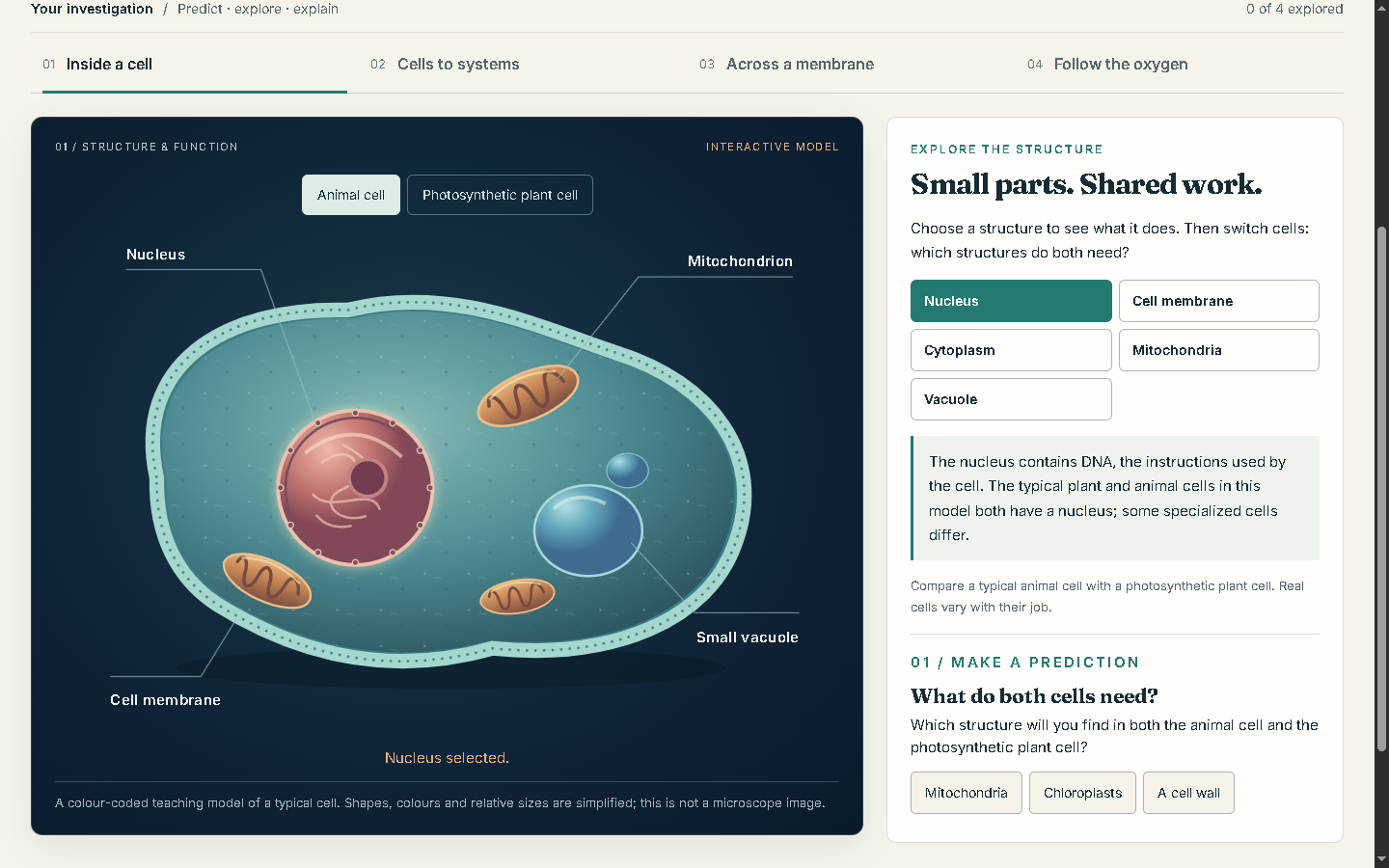
- Compare cell structures. Select structures in a typical animal cell and a photosynthetic plant cell. Find mitochondria in both, then explain why both cells need them.
- Cells, tissues, organs, systems. Zoom from one cardiac muscle cell to cardiac muscle tissue, the heart, and the circulatory system.
- Diffusion and osmosis. Compare diffusion with osmosis. Step the model, track the water counts, and use the evidence to explain what crosses the membrane.
- Circulatory loop. Follow blood to the lungs, back to the heart, and out to the body. An artery leaves the heart and is not always oxygen-rich.
- Free. No login, no email, no sign-up.
- Runs in the browser.
- Nothing a student does is saved or sent.
How to use it in class
- Start with a prediction. Choose a prediction in the first investigation: which structure will you find in both cells? A prediction is a starting idea, not a grade.
- Test it in both cells. Select mitochondria in the animal cell, switch to the photosynthetic plant cell, and select mitochondria again. Use the model to explain what both cells need.
- Connect the evidence. Explore the four cell-to-system levels. In the membrane investigation, predict what moves, then take at least three osmosis steps before choosing an explanation.
- Walk the loop. Trace the six stops in order. Identify where oxygen enters the blood and where it reaches body cells. Use the feedback to revise your explanation.
Curriculum link
Partial support for selected cells and body-systems outcomes in Manitoba's renewed Grade 8 Science curriculum. It does not cover every part of those outcomes.
- SCI.8.E.20: Specialized cell structures.
Demonstrate the understanding that cells have specialized structures for particular functions. Include the following: organelle, cytoplasm, cell membrane, cell wall, nucleus, mitochondria, chloroplast, vacuole.
The cell comparison shows each of those parts and explains its function. Students test a prediction about mitochondria in both cells. - SCI.8.E.21: Cells, tissues, organs and systems.
Demonstrate an understanding of the structural and functional relationships among cells, tissues, organs, and organ systems.
The zoom follows one cardiac muscle cell up to the circulatory system. It does not teach stem cells or unicellular and multicellular organisms. - SCI.8.E.22: Diffusion and osmosis.
Demonstrate the understanding that in living organisms, cells contribute to homeostasis to maintain conditions required for life.
The particle model steps diffusion and osmosis across a membrane. - SCI.8.E.23: The circulatory system.
Demonstrate an understanding of the structure and function of the human circulatory system in maintaining homeostasis.
The loop traces body capillaries, the return to the heart, the lungs, and the path back out to the body.
Contains information from the Government of Manitoba, licensed under the OpenMB Information and Data Use License (Manitoba.ca/OpenMB). OpenMB licence.
Honest limits
- Organelles are enlarged and simplified so a class can see them.
- The heart and circulation models are simplified teaching illustrations, not medical diagrams.
- The particle model uses a handful of dots, not a count of real molecules.
- Partial support for SCI.8.E.20 to E.23 only. It does not teach cell theory, the conditions cells need to grow, stem cells, or unicellular and multicellular organisms.
- Not a diagnosis or a grade.
Credits
- Science: OpenStax Biology 2e, by Mary Ann Clark, Matthew Douglas, and Jung Choi: cell structure, osmosis and circulation. Current web edition: CC BY-NC-SA 4.0. Used as a factual reference only; no OpenStax text or figures are reproduced. Licence: https://creativecommons.org/licenses/by-nc-sa/4.0/. Also the National Heart, Lung, and Blood Institute page How the Heart Works.
- Curriculum: Manitoba Education and Early Childhood Learning, renewed Grade 8 Science, partial support for SCI.8.E.20 to E.23.
- Made by: An independent teaching resource from Milestone Teachers.
Sources
Checked against the sources below on 23 October 2026.
- Manitoba Education and Early Childhood Learning: Science: Grade 8
- OpenStax: Biology 2e
- Creative Commons: CC BY-NC-SA 4.0
- National Heart, Lung, and Blood Institute: How the Heart Works
All interactive labs · New curriculum guides
After the lab
More labs for Grade 8
- Debug the Boundary Counter (Computational thinking)