Free interactive · Manitoba Grade 4 Science · Energy in action
Energy Sources Lab: follow the energy, then name the source
Students trace energy from a source to living, heating, moving or charging, sort hydroelectric, fossil fuels, nuclear, wood, wind and solar, and follow water through a simplified hydro dam. It is free, runs in the browser, and needs no login or email.
Free · No login · No email · Nothing saved or sent
Milestone Teachers · Manitoba Grade 4 Science · Last reviewed
Open Energy Sources Lab (free, full screen) · Manitoba classroom science
What it is
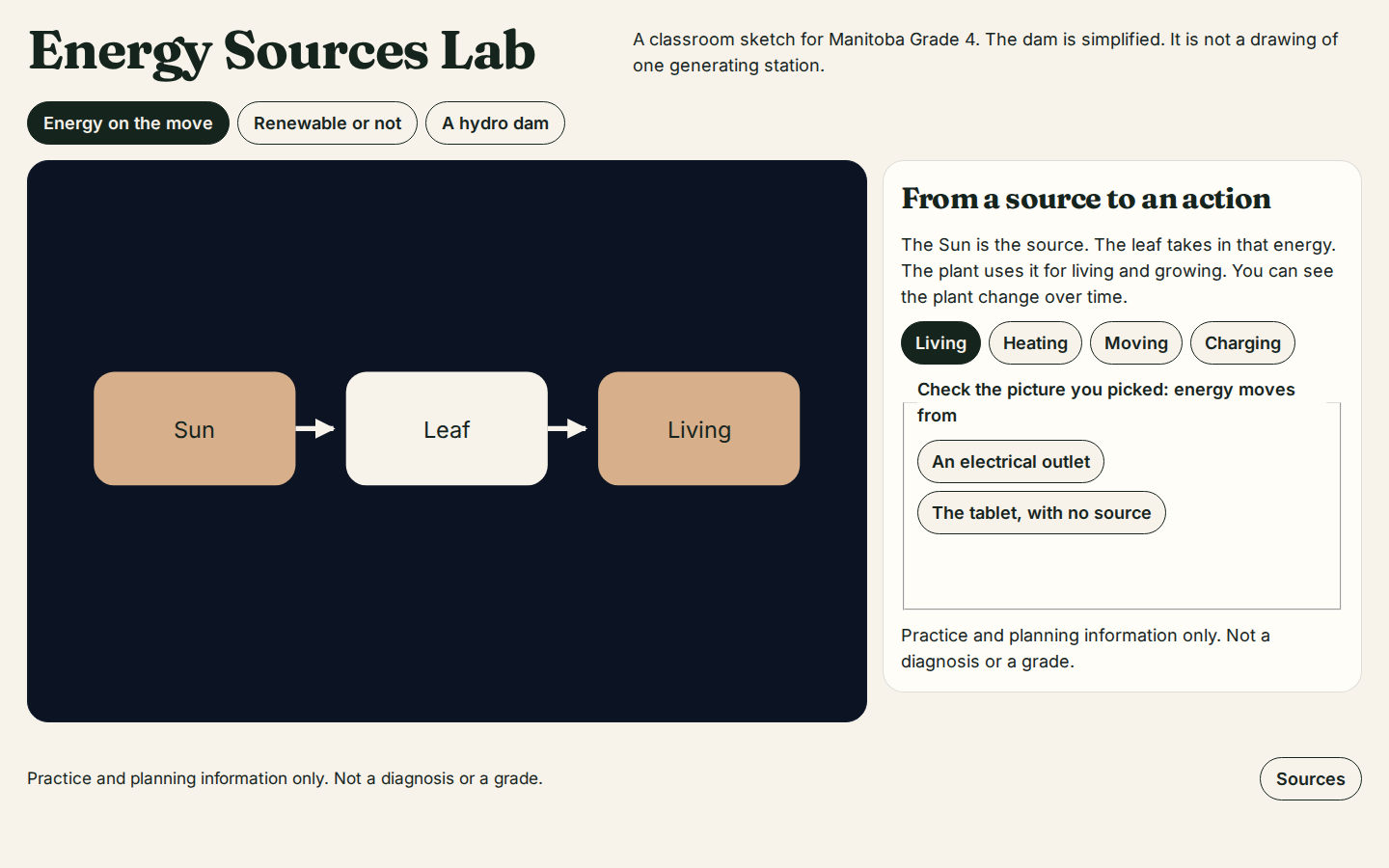
- Four energy chains. Sun to a leaf for living, Sun to a sidewalk for heating, wind to a kite for moving, and an outlet to a tablet for charging.
- Renewable or not. Hydroelectric, wood, wind and solar can be renewable. Fossil fuels and nuclear fuel are not.
- A hydro dam. Water above the station falls through a penstock, spins a turbine and turns a generator.
- Free. No login, no email, no sign-up.
- Runs in the browser.
- Nothing a student does is saved or sent.
How to use it in class
- Read the living chain. The Sun, the leaf and living are already on the screen. Then switch to heating.
- Name the source. Ask where charging starts. The outlet is the source.
- Sort six sources. Renewable means it is replaced about as fast as it is used.
- Follow the water. Start above the dam. Tap until the generator.
Curriculum link
Partial support for selected energy outcomes in Manitoba's renewed Grade 4 Science curriculum.
- SCI.4.E.6: Energy transfer.
Demonstrate the understanding that energy can transfer from a source (e.g., Sun, fuel, motor, electrical outlet) to objects or organisms to cause actions (e.g., living, heating, moving, charging).
Each chain names a source, an object and one of those actions. - SCI.4.E.7: Senses detect energy.
Demonstrate an understanding of the varied ways that humans use senses to detect energy in action.
The chains name what a student can see or feel: a growing plant, a warm sidewalk, a moving kite, a lit screen. - SCI.4.E.8: Renewable and non-renewable.
Demonstrate an understanding of the differences among renewable and non-renewable energy sources.
The sort covers hydroelectric, fossil fuels, nuclear, wood, wind and solar.
Contains information from the Government of Manitoba, licensed under the OpenMB Information and Data Use License (Manitoba.ca/OpenMB). OpenMB licence.
Honest limits
- The dam is a sketch. Some stations use a long penstock and others sit at the intake.
- Wood is renewable when new trees replace the ones that are cut.
- Partial support for SCI.4.E.6 to E.8. Students follow four transfers, sort six sources, and sketch one hydro dam. The activity does not cover every sense or every source.
- Not a diagnosis or a grade.
Credits
- Science: Manitoba Hydro, for hydroelectric generation in Manitoba. Natural Resources Canada, for hydroelectric, wind, solar and bioenergy as renewable energy.
- Curriculum: Manitoba Education and Early Childhood Learning, renewed Grade 4 Science, partial support for SCI.4.E.6 to E.8.
- Made by: An independent teaching resource from Milestone Teachers.
Sources
Checked against the sources below on 16 October 2026.
- Manitoba Education and Early Childhood Learning: Science: Grade 4
- Manitoba Hydro: Generation
- Natural Resources Canada: Hydroelectric energy
- Natural Resources Canada: Renewable energy