Manitoba Grade 5 Science Long Range Plan | Renewed Curriculum
Plan a Grade 5 Manitoba Science year from September to June with a 20-page print-and-write long-range plan. Includes a suggested September-to-June sequence for all 31 coded learning outcomes, plus 36 checklist rows covering all compulsory content. The 20-page print-and-write plan includes month pages, a year overview, coverage trackers, a blank month page and teacher notes. Use it to discuss timing and record your local changes. The weather and climate pages distinguish short class observations from long-term regional climate records and prompt teachers to compare station, variable, units, period and statistic. This is an independent English-program planning resource, not a complete lesson unit, assessment or reporting guide, editable file, French edition, ministry publication or accessibility certification. (c) Milestone Teachers | Created by an Ontario Certified Teacher
USD $6.95
Single-teacher licence.
Included files
- Manitoba-Science-Grade-5-Long-Range-Plan-2026.pdf
Instant download after checkout · Refund for a missing file, duplicate purchase, incorrect charge, or a resource that does not match its description · Made by an Ontario Certified Teacher
Resource licence and purchase terms · Browse resources
Look inside
Selected pages from this resource.
360° teaching & learning profile
A teacher planning view of a 20-page Grade 5 Manitoba Science long-range plan. It organizes a suggested September-to-June sequence and coverage checks; it does not replace lesson design, assessment planning or local curriculum judgment.
Learning goals
- Choose a September-to-June starting sequence and make local changes visible.
- Track when outcomes are planned, taught and revisited.
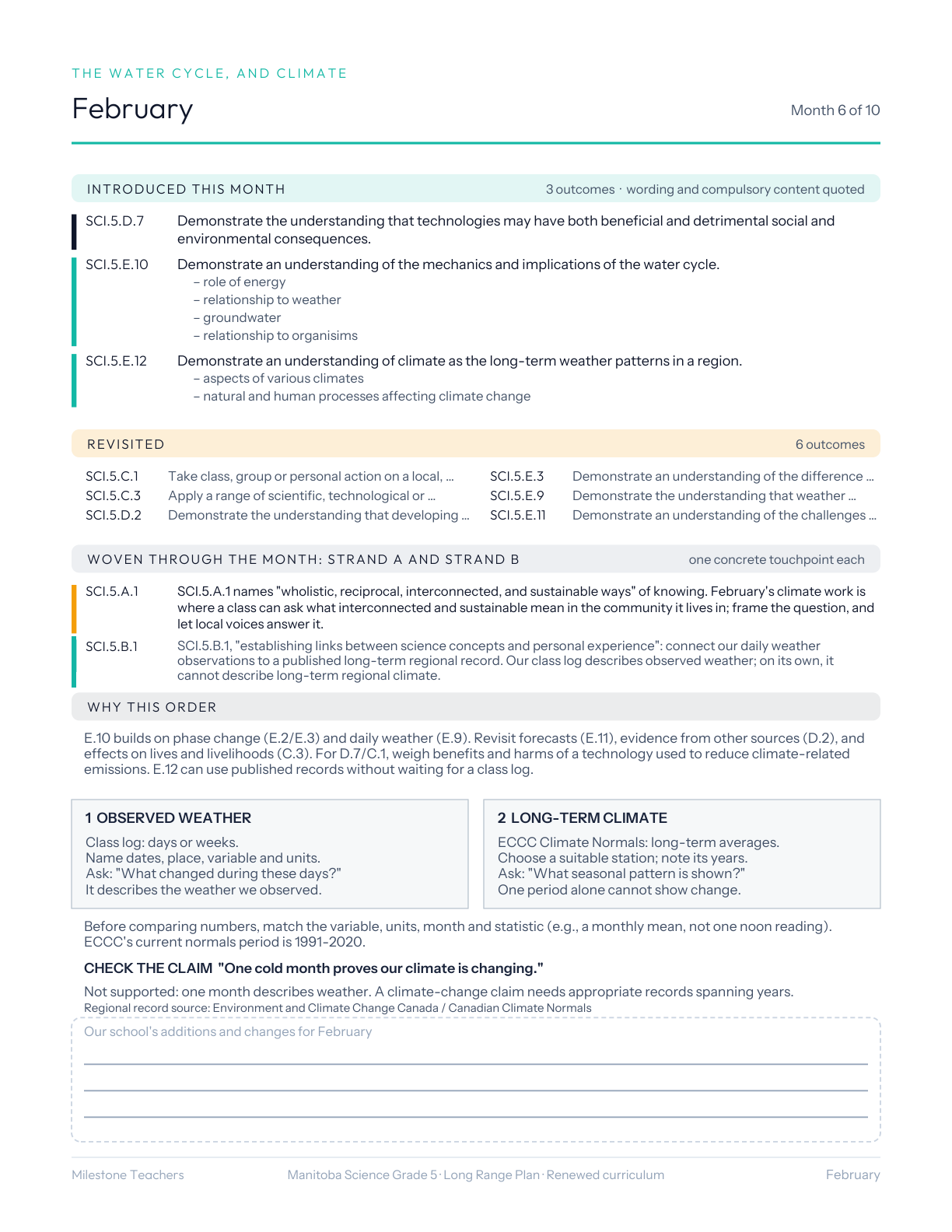
- Keep daily weather observations distinct from long-term climate records when planning the weather and climate portion of the year.
Starting points
- Read the current provincial framework alongside the plan before assigning dates or activities.
- Know the division calendar, locally required learning opportunities and classroom readiness before using the suggested sequence.
- Choose a suitable local or regional source before asking learners to compare weather observations with climate information.
Curriculum connection
Manitoba Grade 5 Science framework
- SCI.5.E.9: Understand that daily weather changes through interactions among solar energy, the atmosphere, water systems and landforms, including water vapour, pressure and wind.
- SCI.5.E.11: Understand challenges in long-term weather prediction and factors meteorologists use in forecasts, including recorded data and patterns.
- SCI.5.E.12: Understand climate as long-term regional weather patterns, including features of climates and natural and human processes affecting climate change.
The plan retains all 31 coded outcomes and 36 checklist rows covering all compulsory content in its planning structure. This summary is not official outcome wording, ministry endorsement or a claim that the resource provides a complete science course.
Differentiation
Local sequencing route
Adapt the suggested order to division requirements, learners, calendar and local community.
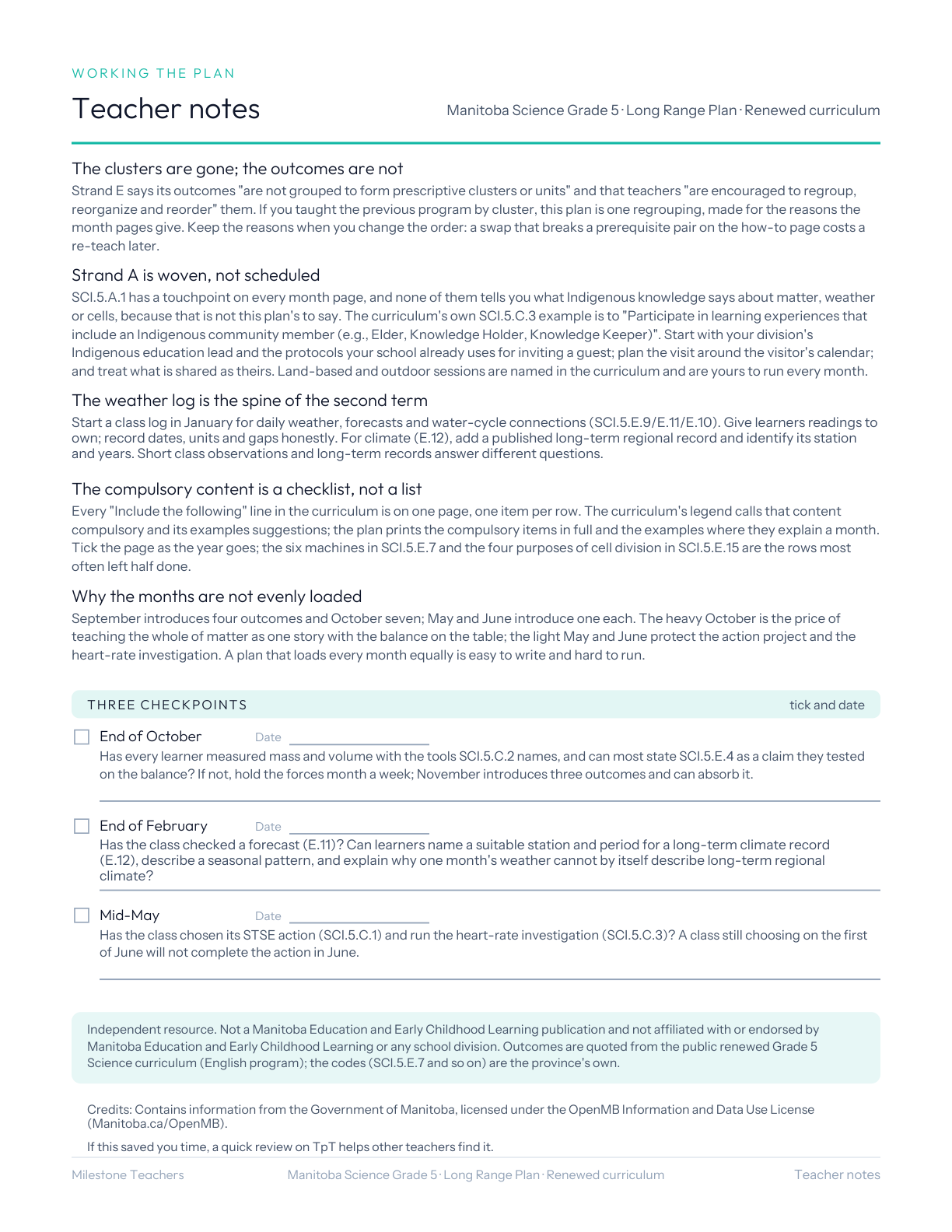
Included: Write-in space on month pages and a blank month page support teacher planning; no alternative lesson sequence is supplied.
Suggested teacher move: Cross out or reorder a proposed month deliberately, then note the evidence or local requirement behind the change.
Weather and climate evidence route
Prepare one careful comparison of short observations and long-term records.
Included: The February page prompts station, variable, units, period and statistic checks; it does not include a student data set or assessment task.
Suggested teacher move: Model the difference between a dated class observation and a long-term regional pattern before asking for an explanation.
Universal Design for Learning
Engagement
Included: The plan contains teacher planning pages and local write-in areas, not differentiated student lessons.
Suggested teacher move: Offer teachers or teams a choice of local phenomena and calendar connections while keeping the same science planning question visible.
Representation
Included: Outcome codes, month pages, coverage trackers and the weather-climate comparison prompt provide planning representations; no alternate-format student materials are included.
Suggested teacher move: Pair the official outcome wording with a simple local planning example, then check that the planned task asks for the intended evidence.
Action and expression
Included: Coverage trackers and write-in boxes support teacher notation; they are not learner assessment tools.
Suggested teacher move: When planning a student task, decide separately which response formats show the science learning and document any changed assessment conditions.
Assessment and next steps
Does the planned sequence show when an outcome is introduced and revisited? Use the coverage trackers to identify a missing or crowded part of the year before writing lessons.
Does a weather-and-climate task distinguish short observations from long-term records? Add the source, station, variable, units, period and statistic before treating the comparison as evidence.
Planning notes
- This is one suggested sequence, not a prescribed order or a complete teaching unit.
- It does not include lesson plans, student assessment, reporting guidance, a French edition or an editable file.
- The PDF is untagged and has inherited low-contrast labels; no PDF-UA, screen-reader or low-vision certification is claimed.
- It is an independent resource and is not affiliated with or endorsed by Manitoba Education or a school division.