Manitoba Grade 6 Earth, Moon & Sun Unit
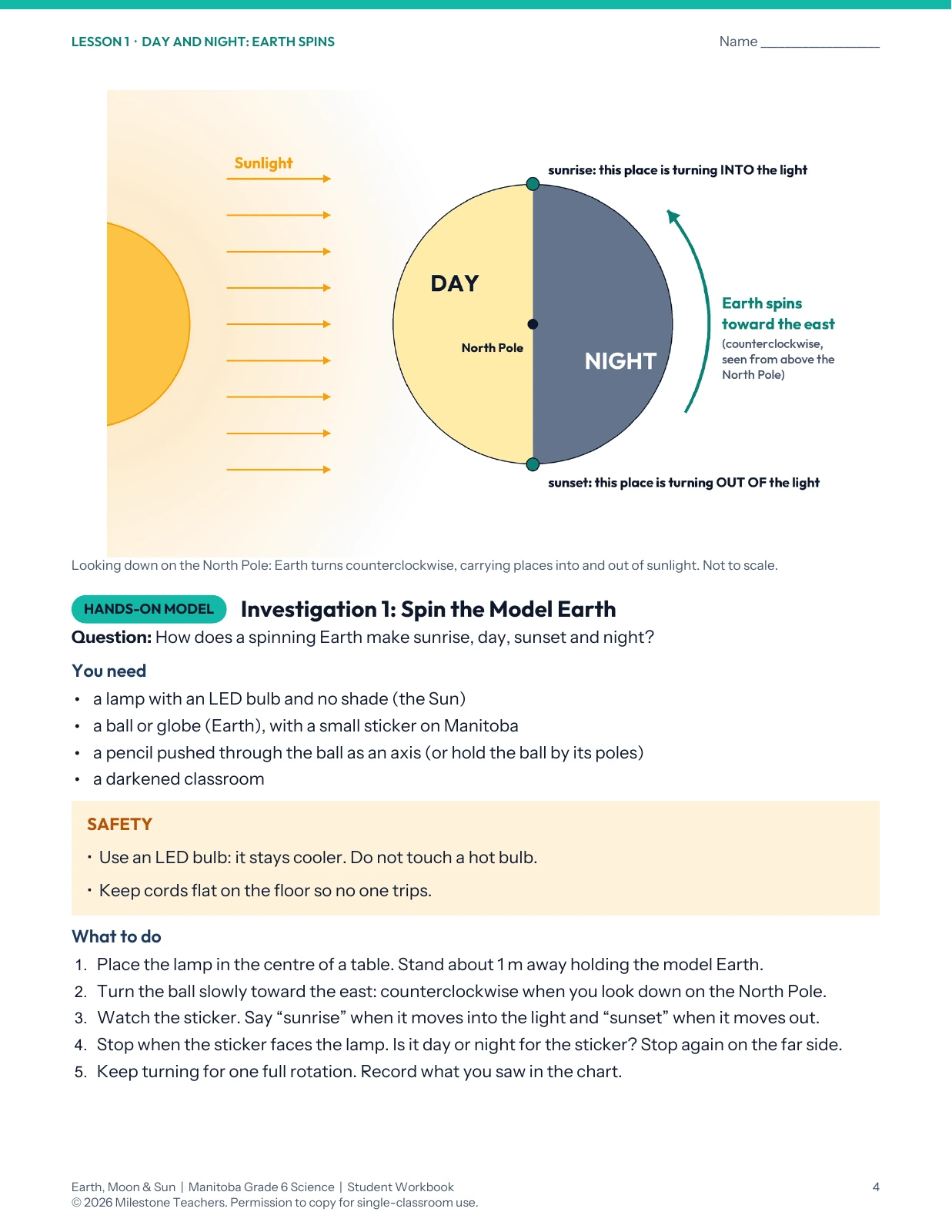
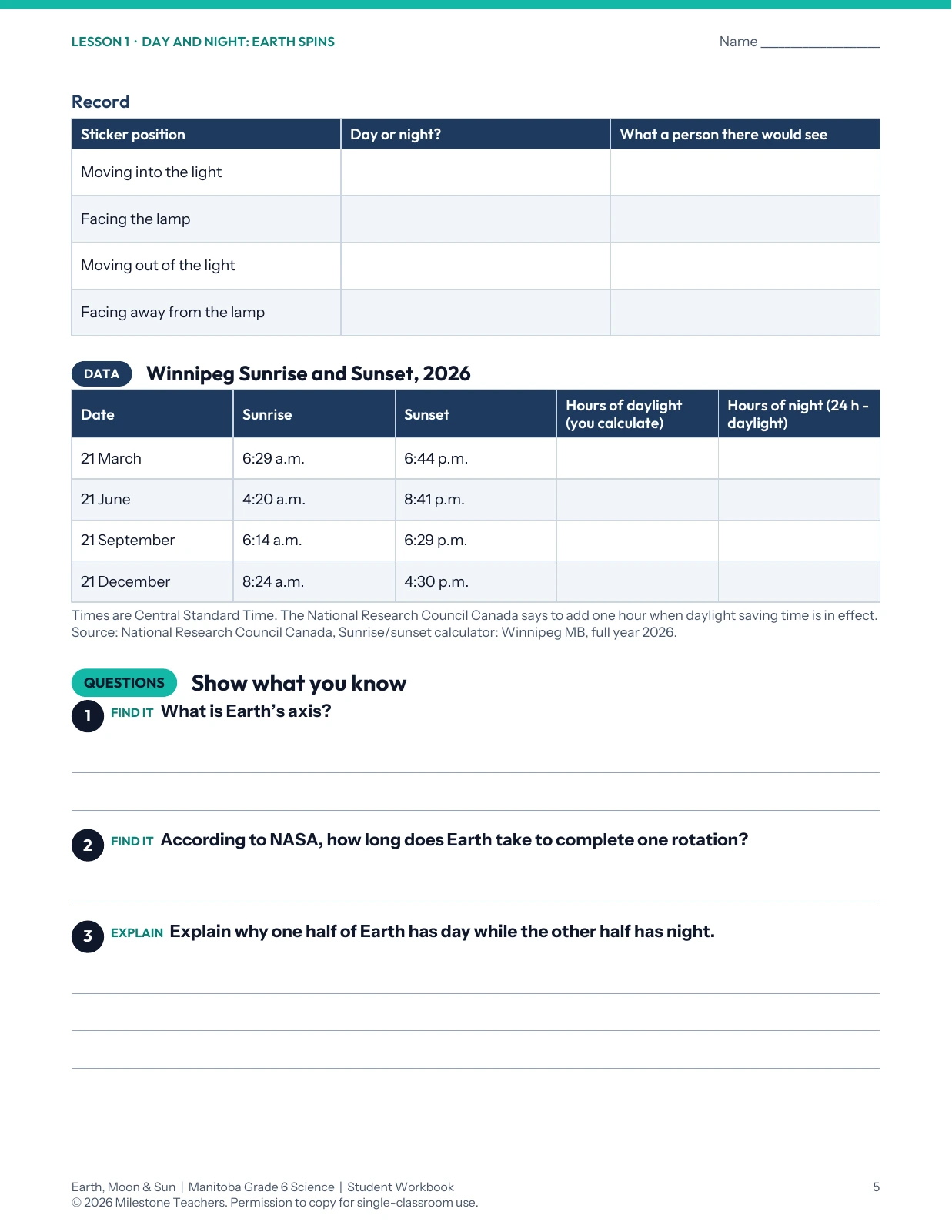
Teach Earth, Moon and Sun through eight Manitoba Grade 6 science lessons, including day and night, shadows, Moon phases and seasons. The ZIP includes a 65-page student workbook, an 80-page accommodated workbook and a 37-page teacher guide with answer keys, plus teaching slides and an offline Seasons Explorer. The sample shows a model investigation and Winnipeg sunrise and sunset data. Targets SCI.6.E.8-E.11 with connections to the other science strands. Created by an Ontario Certified Teacher; not reviewed or endorsed by Manitoba Education.
$21.21
The licence included with each resource governs classroom use and sharing. Purchase terms cover payment and download access.
Included files
- MB6-Earth-Moon-Sun-Unit.zip
Check the current product availability and price before paying through Stripe. Private downloads follow payment confirmation.
Resource licence and purchase terms · Browse resources
Look inside
Selected pages from this resource.
360° teaching & learning profile
A planning view of the current Earth, Moon & Sun unit: eight linked lessons on Earth’s motions, Moon phases, seasons and the Sun. Keep the science explanation visible while adapting reading, pacing, observation conditions and response format.
Learning goals
- Use a model and local data to explain that Earth’s rotation causes day and night.
- Use shadow, orbit and daylight evidence to distinguish rotation, revolution and axial tilt.
- Explain Moon phases as changing views of the Moon’s sunlit half, rather than Earth’s shadow.
- Use evidence to reject Earth-Sun distance as the cause of Manitoba’s seasons and explain the roles of tilt, sunlight angle and daylight.
- Describe the Sun as a star and use a scale model, safe indirect observation and daylight data in an evidence-based explanation.
Starting points
- Check whether learners can read a clock, calculate elapsed time and interpret a simple table or line graph before local sunrise, sunset and shadow tasks.
- Clarify the everyday meanings of spin, orbit, shadow, reflected light and model before using the unit vocabulary.
- Establish safe routines for lamps, cords, outdoor observation and teacher-made pinhole viewers before practical work.
- Prepare respectful discussion routines before Lesson 5; use the named publicly shared source rather than asking learners to invent community knowledge.
Curriculum connection
Manitoba Grade 6 Science framework
- SCI.6.E.8: Earth’s rotation, day and night, sunrise and sunset.
- SCI.6.E.9: Earth and Moon motions connect to a day, month, year, seasons, solstices and equinoxes.
- SCI.6.E.10: Earth’s tilt and revolution change daylight hours and seasonal temperature.
- SCI.6.E.11: The Sun is a star like billions of others and the Solar System's central source of energy, light and gravity; include heat and Moon phases.
Planning summaries, not official outcome wording or ministry endorsement. The guide maps supporting Indigenous Knowledge Systems, Science Identity, Practical Science and Nature of Science outcomes; it does not claim a complete Grade 6 science course.
Differentiation
Accommodated route
Maintain the lesson sequence and shared answer key while reducing reading and response load.
Included: An 80-page accommodated workbook: a simpler reading in the same paragraph order, large print, word banks, sentence starters and selected questions with the original numbers retained.
Suggested teacher move: Read one section and its diagram together, model one response, then let a learner explain with a labelled drawing or oral response when extended writing is not the intended evidence. Record changed assessment conditions.
Core investigation route
Move from a prediction or question to observed or supplied evidence and a scientific explanation.
Included: A 65-page standard workbook, models and investigations, local 2026 data tables, retrieval warm-ups, exit tickets, CER prompts and answer key.
Suggested teacher move: Before each model, ask what it can show and what it cannot show. Pause after a prediction and ask which observation or data value would test it.
Extension route
Increase reasoning and transfer after the core idea is secure.
Included: A Go further task in every lesson, including shadow-clock redesign, Moon-cycle prediction, Southern Hemisphere daylight comparison, tilt variations and a career interview.
Suggested teacher move: Ask learners to name the evidence that would change their conclusion or the limit of a model before adding a new calculation or task.
Universal Design for Learning
Engagement
Included: Hands-on models, an outdoor/data-only alternative for shadow work, a Moon journal option using NASA data, a land-observation task and an action project.
Suggested teacher move: State the specific science question before a choice of context or observation route, then use the exit ticket to select one focused next step.
Representation
Included: Standard and simpler same-order readings, large print, vocabulary, diagrams, teaching slides with notes, lamp-and-ball models and data tables. The guide describes an included Seasons Explorer with a flat top-view fallback if 3D cannot display.
Suggested teacher move: Pair a diagram or model with the same vocabulary in speech and text. Explicitly compare the model to the phenomenon so a simplified representation does not become the explanation.
Action and expression
Included: Tables, graphs, labelled diagrams, practical observations, short exit tickets, CER prompts, a unit assessment and a four-criterion action-project rubric with annotated exemplars.
Suggested teacher move: When handwriting or reading fluency is not the target, accept a spoken explanation, labelled model or scribed response while assessing the same science criterion; do not compare the two assessment editions as equivalent totals.
Assessment and next steps
Does the learner distinguish a model’s apparent movement from the scientific cause of day and night? Return to one lamp-and-ball position and ask the learner to label where sunrise and sunset occur before calculating times.
Can the learner explain that Moon phases are views of the sunlit half rather than Earth’s shadow? Reposition the Moon model above the learner’s head at full Moon and contrast a phase with the rare eclipse condition.
Does the seasons claim use the opposite-hemisphere and perihelion/aphelion evidence instead of the distance misconception? Ask for one numeric datum and one hemisphere comparison, then revisit the tilt, sunlight angle and daylight evidence.
Does the action-project recommendation use seasonal daylight data and the class survey, then connect the recommendation to a scientific explanation? Separate data accuracy, explanation and feasibility. Recheck daylight-saving adjustment before interpreting a September sunset time.
Which science ideas persist in the summative assessment? Use the coverage map and shared item IDs to choose a targeted re-teach; treat the standard 42-mark and accommodated 33-mark tests as different forms, not interchangeable scores.
Planning notes
- The resource is not reviewed, approved or endorsed by Manitoba Education and Early Childhood Learning.
- It covers space-science outcomes SCI.6.E.8–E.11 and connected strands; it does not teach the other Grade 6 scientific-knowledge groups.
- The accommodated edition is a differentiated classroom resource, not an individual education plan or diagnostic assessment.
- The listed 2026 sunrise, sunset and Moon dates are year-specific; use the linked sources for a different year.
- The unit’s Indigenous content uses one public Ininew source and does not replace relationships with local Nations, Elders or Knowledge Keepers.
- The PDFs are provided for reading and printing, but this profile does not promise screen-reader compatibility, assistive-technology performance, print results or interactive performance on every device.
- Use sun-safety instructions as written: never look directly at the Sun, including through sunglasses; the teacher makes the pinhole viewer.
Continue your planning
- Manitoba Grade 6 Science Full Year Bundle
Plan all three scientific-knowledge groups with the three-unit bundle.
- Manitoba Grade 6 Science NEW Curriculum | FREE Year Plan + Seasons Lesson
Try the free year plan and seasons lesson before choosing complete teaching resources.