Manitoba Grade 6 Science Full Year Bundle
Plan the three Manitoba Grade 6 scientific-knowledge groups with 28 lessons across Earth, Moon & Sun; Forces & Energy; and Heredity, Diversity & Fossils. Receive three separate unit ZIPs with standard and accommodated workbooks, teacher guides, answer keys, teaching slides and each unit’s offline interactive. The three ZIPs contain 601 PDF pages in total, including teacher and start guides. The Forces & Energy unit also includes structured offline reading versions with separate teacher keys and speaker notes. Covers SCI.6.E.1-E.17, with connections to the other strands; it is not a claim to assess every outcome in those strands. Created by an Ontario Certified Teacher; not reviewed or endorsed by Manitoba Education.
$51.01
The licence included with each resource governs classroom use and sharing. Purchase terms cover payment and download access.
Included files
- MB6-Earth-Moon-Sun-Unit.zip
- MB6-Forces-Energy-Unit.zip
- MB6-Heredity-Diversity-Fossils-Unit.zip
Check the current product availability and price before paying through Stripe. Private downloads follow payment confirmation.
Resource licence and purchase terms · Browse resources
Look inside
Selected pages from this resource.
360° teaching & learning profile
A teacher planning view of three linked Manitoba Grade 6 science units: Earth, Moon & Sun; Forces & Energy; and Heredity, Diversity & Fossils. The 28 lessons build evidence-based explanations while allowing teachers to vary reading, pacing, materials and response format.
Learning goals
- Use observations, measurements, models and data to make a claim, name the evidence and explain the connection.
- Distinguish what a model can show from the phenomenon it represents, then revise an explanation when evidence conflicts with it.
- Explain how forces, energy, Earth-Sun-Moon motion, inherited information, classification and fossils account for observable patterns.
- Plan a fair comparison, identify a safety constraint and use results to improve a design, explanation or key.
- Communicate scientific thinking through a labelled diagram, table, model, oral explanation or concise written response when the science criterion is the same.
Starting points
- Check reading of a scale, elapsed time, simple tables and graphs before data-heavy tasks; support the calculation separately from the science explanation.
- Establish routines for predictions, shared equipment, measurement, observation and respectful evidence-based disagreement before investigations.
- Teach and revisit the everyday meanings of model, evidence, force, energy, orbit, trait, species, fossil and classification before asking learners to use them precisely.
- Prepare safety routines for lamps, outdoor solar observation, water, low-voltage circuits, materials and allergies before the relevant lesson.
- Use attributed public Indigenous sources in their stated context; do not ask learners to supply community knowledge or treat one source as representing all Nations.
Curriculum connection
Manitoba Grade 6 Science framework
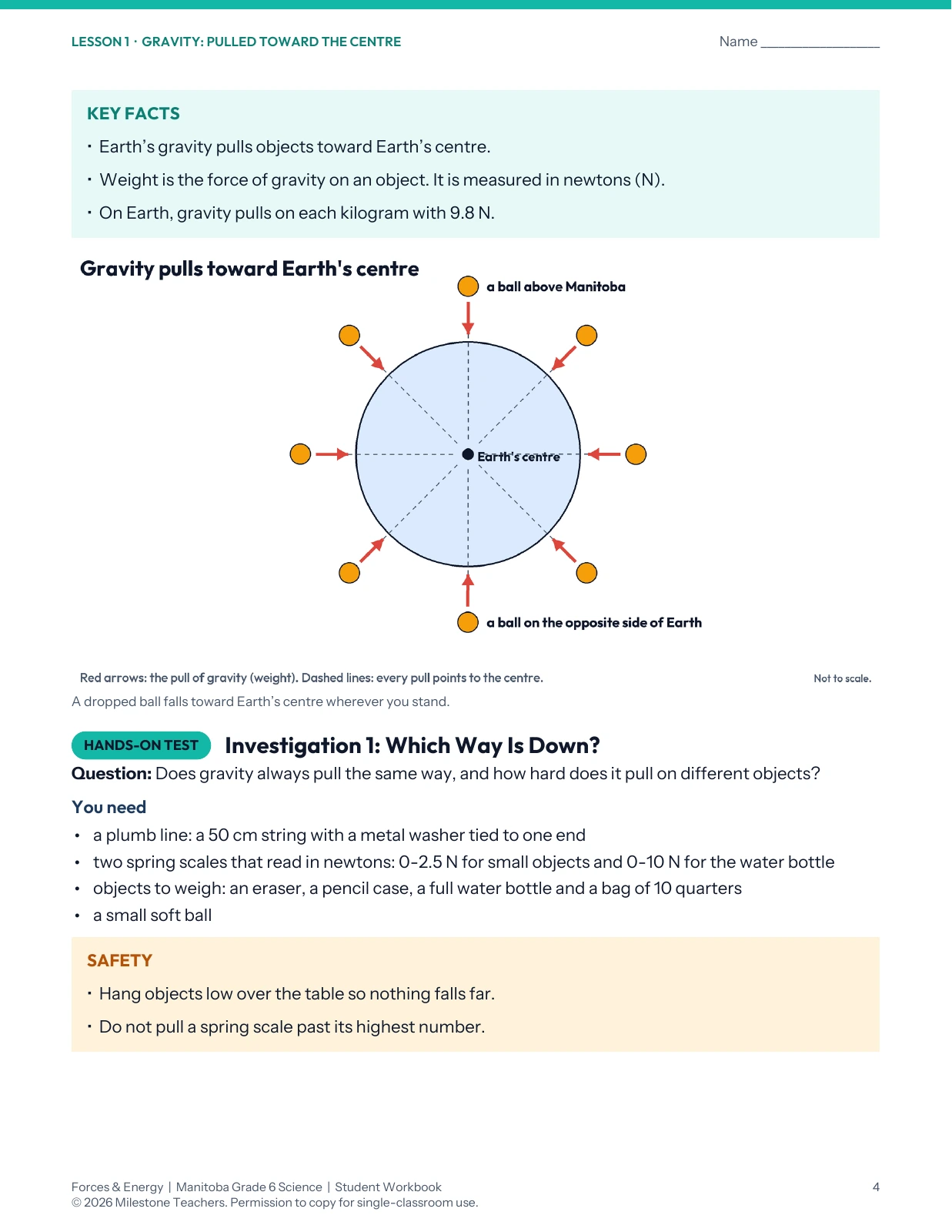
- SCI.6.E.1: Gravity acts toward Earth’s centre.
- SCI.6.E.2: Forces can oppose gravity.
- SCI.6.E.3: Explain buoyancy using opposing forces, Archimedes’ principle, volume, density and mass.
- SCI.6.E.4: Objects can store energy.
- SCI.6.E.5: Energy transfers cause events.
- SCI.6.E.6: Battery circuits transfer energy to components and the environment.
- SCI.6.E.7: Apply precautions around electricity.
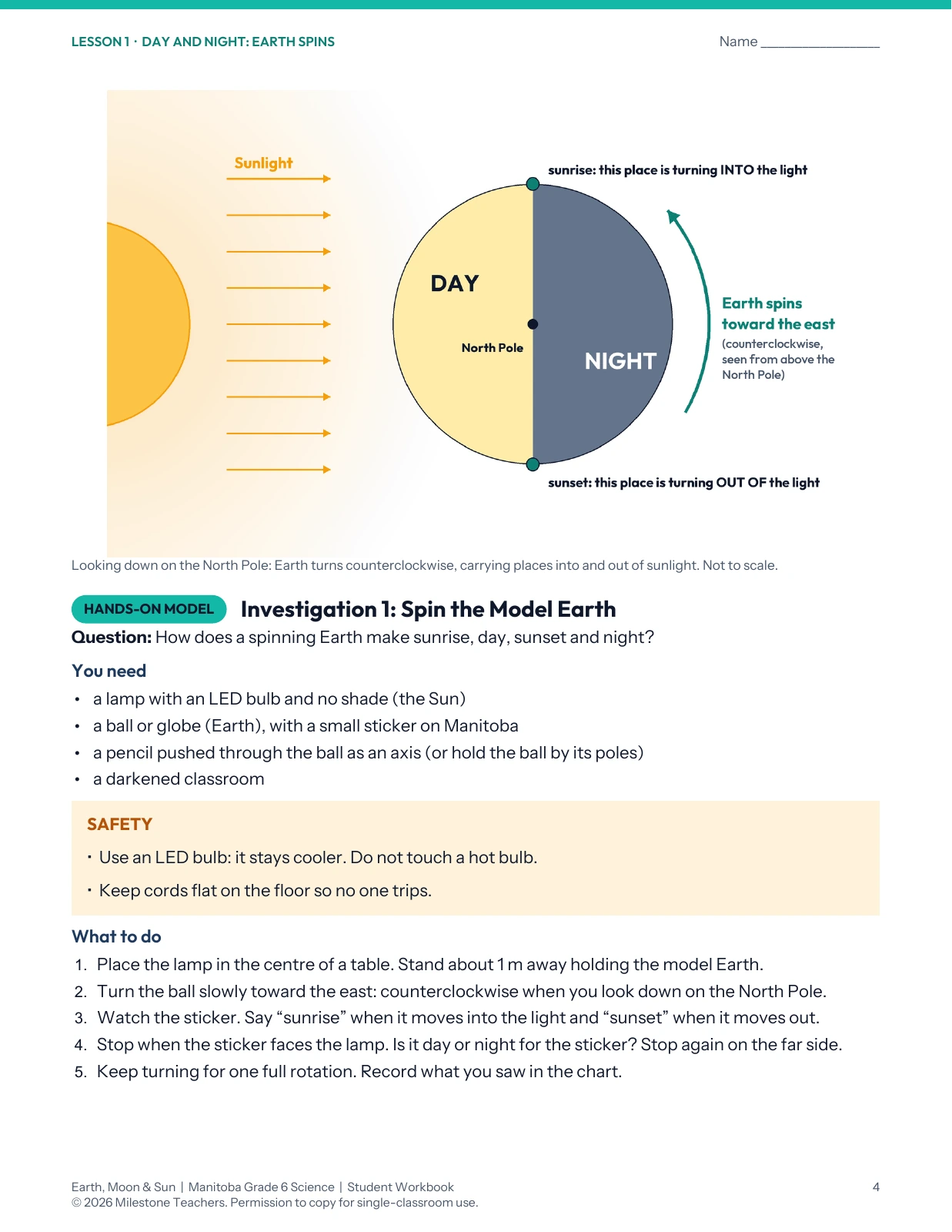
- SCI.6.E.8: Earth’s rotation connects to day, night, sunrise and sunset.
- SCI.6.E.9: Earth and Moon motions connect to a day, month, year, seasons, solstices and equinoxes.
- SCI.6.E.10: Earth’s tilt and revolution change daylight hours and seasonal temperature.
- SCI.6.E.11: Describe the Sun as one of billions of stars and as the Solar System’s source of energy, light, heat and gravity; explain Moon phases as changing views of the Moon’s sunlit half.
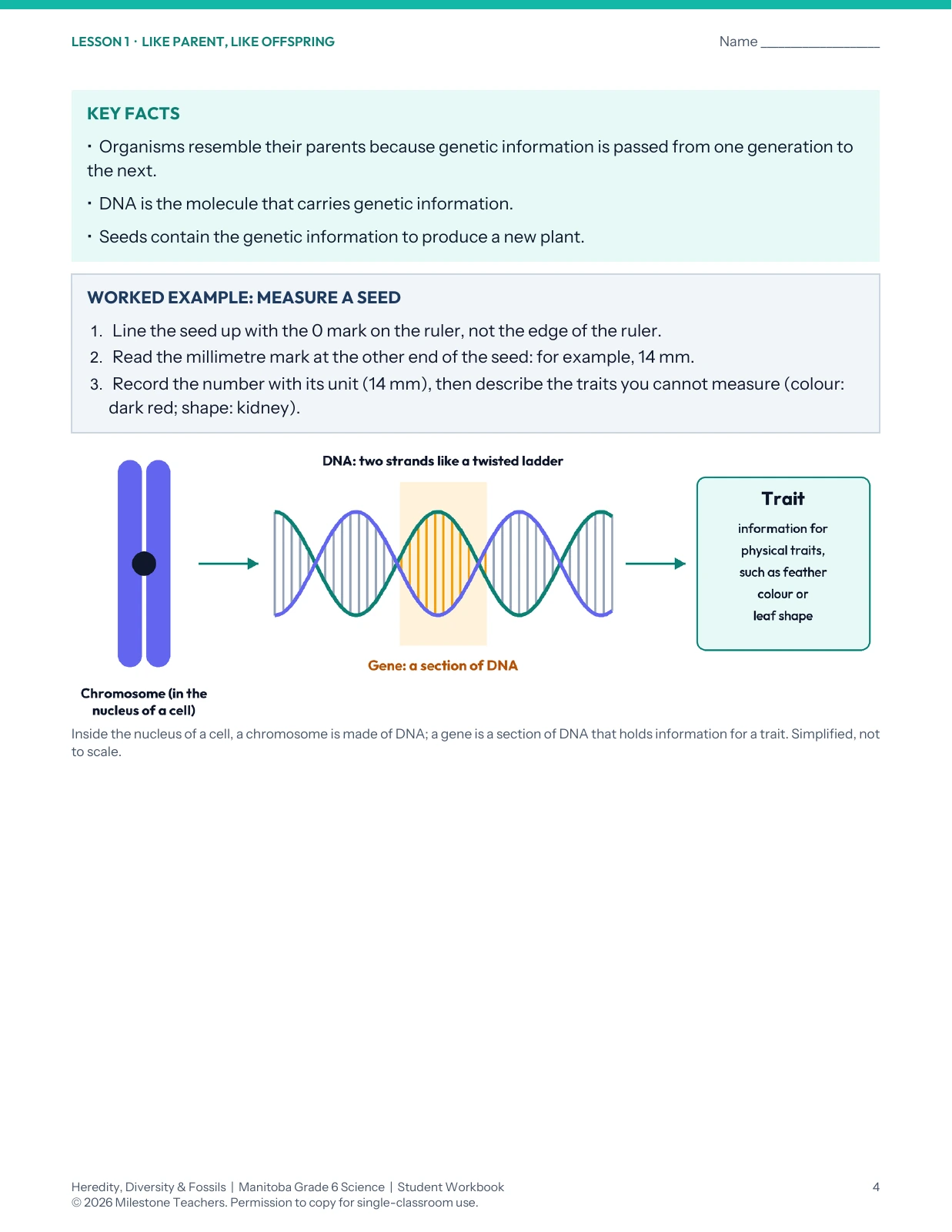
- SCI.6.E.12: Offspring resemble parents because genetic information passes between generations.
- SCI.6.E.13: Traits, skills and behaviours have genetic, environmental, social and learned components.
- SCI.6.E.14: Use observable traits, taxonomy and dichotomous keys to categorize organisms systematically.
- SCI.6.E.15: Use fossils as evidence of how organisms changed over time.
- SCI.6.E.16: Use viable offspring to investigate species and hybrids.
- SCI.6.E.17: Sexual reproduction produces offspring similar to, but not identical with, their parents.
Planning summaries for SCI.6.E.1–E.17, not official wording or ministry endorsement. The units support links to other science strands, but do not claim to teach or assess every outcome in those strands.
Differentiation
Core investigation route
Keep a shared science question while learners predict, observe or use supplied data, and explain what the evidence supports.
Included: Each included unit supplies a standard workbook, teacher materials, answer support and teaching slides; its interactive remains a unit resource rather than the course itself.
Suggested teacher move: State the evidence goal before the activity. Pause after the prediction, ask which observation or value would test it, and have learners separate result from explanation.
Accommodated route
Maintain the current lesson idea while reducing reading, writing or task-management load.
Included: Each unit includes an accommodated workbook alongside its standard workbook, with simpler readings and response scaffolds described in the member profiles.
Suggested teacher move: Read one section and its diagram together, model one response, then accept an oral explanation, labelled drawing or scribed response when extended writing is not the intended evidence. Record changed assessment conditions.
Extension and transfer route
Deepen reasoning after the core idea is secure instead of adding more of the same practice.
Included: Use the units’ design, data, model, classification and explanation tasks to compare cases, test a revision or identify a model’s limit.
Suggested teacher move: Ask what evidence could change the conclusion, what makes a comparison fair, or where the model stops matching the phenomenon before assigning the next challenge.
Universal Design for Learning
Engagement
Included: Concrete investigations, models, data questions, design work, local-context examples and optional interactive rehearsal offer different entry points to the same science goals.
Suggested teacher move: Offer a bounded choice of context, partner role or observation route after naming the target question. Use a short exit response to choose one focused next move.
Representation
Included: The unit materials combine standard and accommodated readings, diagrams, slides, vocabulary, models, tables and selected structured reading supports.
Suggested teacher move: Pair the spoken explanation with the same diagram, object or model. Say what the representation shows and does not show, and precheck files on the devices learners will use.
Action and expression
Included: Learners can collect observations, annotate force arrows, build and revise a design or key, interpret data, draw models and complete short explanations.
Suggested teacher move: Keep the evidence criterion stable while varying response format. Assess the science explanation rather than handwriting, reading speed or visual neatness unless that is the stated target.
Assessment and next steps
Can the learner use a rotation, shadow, phase or daylight observation to explain the pattern rather than repeat a memorized statement? Return to one lamp-and-ball position or one data row. Ask for the observation first, then the claim it supports; contrast a phase with an eclipse if needed.
Does the learner distinguish measured results from an explanation and use test evidence to justify a force, buoyancy, energy or circuit conclusion? Re-teach with one observable example, labelled arrows or one known-good low-voltage circuit. Ask for a sketch, measurement and reason for one design revision.
Does the learner use an observable trait, a key decision, a layer relationship or a fossil feature as evidence instead of making a broad unsupported claim? Model one two-choice split or one layer comparison, then have the learner name the observation and the conclusion it supports before revising the key or explanation.
Can the learner transfer the cross-unit routine: claim, relevant evidence, reasoning, and a stated limit or next test? Give one familiar and one new case. Conference briefly on evidence selection, then reteach only the missing step rather than repeating the entire unit.
Planning notes
- This resource is not reviewed, approved, endorsed or certified by Manitoba Education and Early Childhood Learning.
- It plans all 17 listed Scientific Knowledge outcomes, SCI.6.E.1–E.17. Connections to other strands are supportive only and do not claim complete coverage or assessment of every outcome there.
- Accommodated materials are classroom supports, not an individual education plan, diagnostic assessment or a guarantee of accessibility.
- Included offline resources and public demos are distinct. This profile makes no universal claim about offline access, device compatibility, 3D display, screen-reader support, assistive technology or printing.
- Year-specific local data and dates in member materials need checking for a different year or location; use current authoritative data when updating them.
- Indigenous content requires the cited source and its context. It does not replace local relationships with Nations, Elders or Knowledge Keepers.
- Follow the relevant guide’s safety directions. Never look directly at the Sun; use supervised low-voltage circuit setups and local allergy or material precautions.
Open the Classify & Fossils Lab: Use this reviewed public Lab to rehearse a dichotomous key and fossil-layer evidence in selected SCI.6.E.14 and SCI.6.E.15 work. It supplements the included unit materials and does not teach the bundle by itself.
Continue your planning
- Manitoba Grade 6 Earth, Moon & Sun Unit
Teach Earth, Moon & Sun as a separate unit.
- Manitoba Grade 6 Forces & Energy Unit
Teach Forces & Energy as a separate unit.
- Manitoba Grade 6 Heredity, Diversity & Fossils Unit
Teach Heredity, Diversity & Fossils as a separate unit.
- Manitoba Grade 6 Science NEW Curriculum | FREE Year Plan + Seasons Lesson
Try the free year plan and seasons lesson before choosing complete teaching resources.