Manitoba Grade 6 Forces & Energy Unit
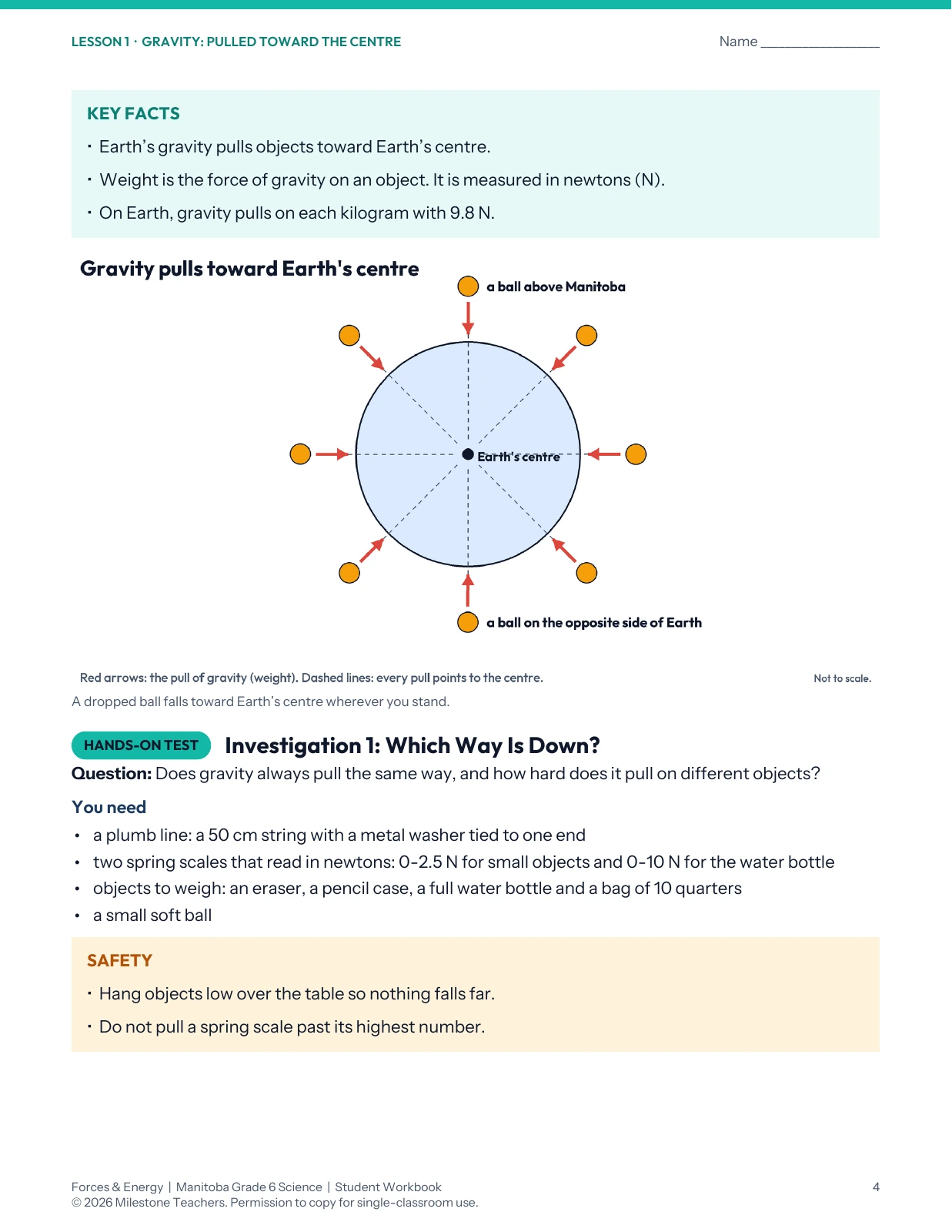
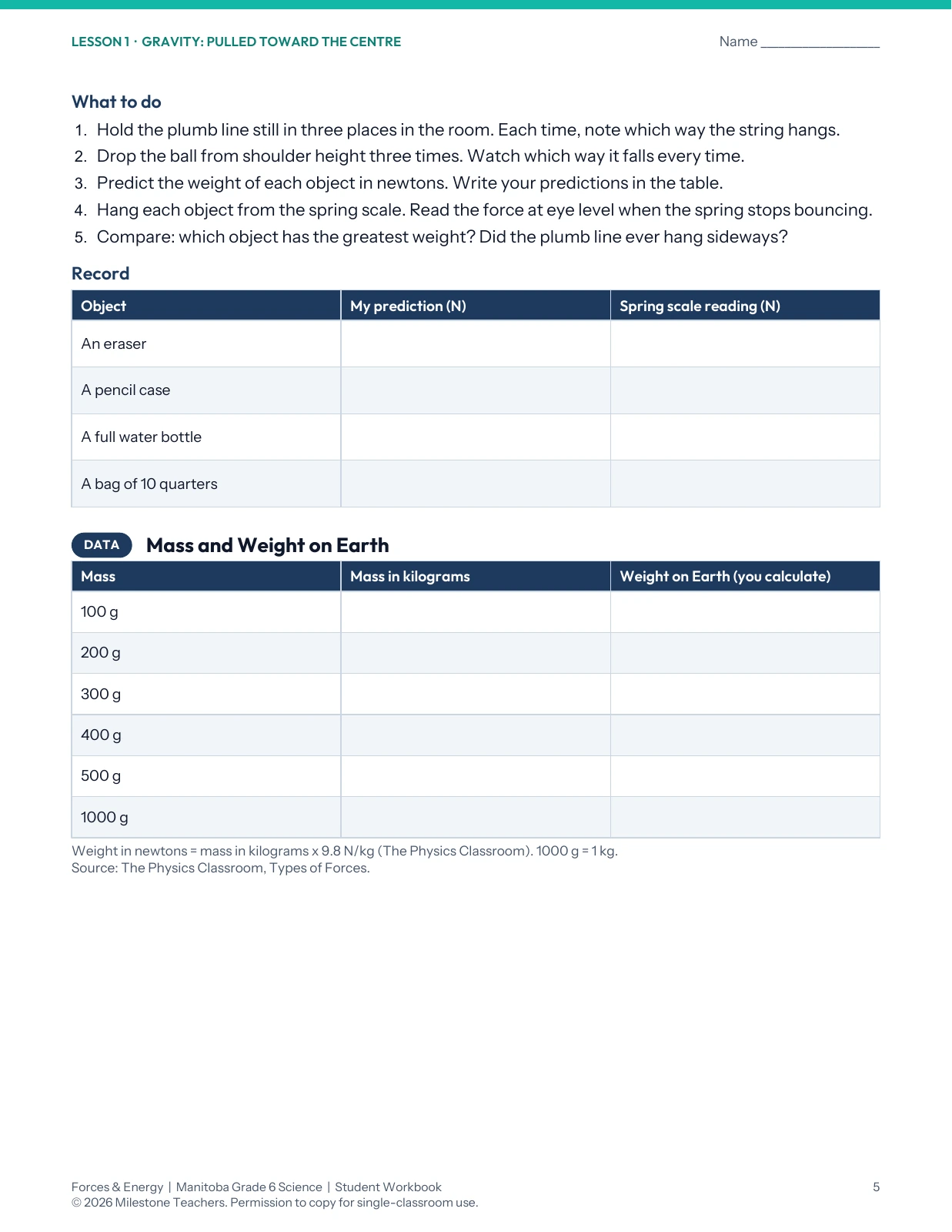
Teach gravity, buoyancy, stored energy, energy transfer and electrical safety through ten Manitoba Grade 6 science lessons. The ZIP includes a 73-page student workbook, a 97-page accommodated workbook, a 40-page teacher guide with answer keys and a one-page start guide, plus 80 editable teaching slides, structured offline reading versions and an offline circuits and buoyancy lab. Student reading files preserve the tasks and include diagram descriptions; teacher keys and slide speaker notes are separate. The sample shows a gravity investigation and a mass-to-weight recording task. Targets SCI.6.E.1-E.7 with connections to the other science strands. Created by an Ontario Certified Teacher; not reviewed or endorsed by Manitoba Education.
$21.21
The licence included with each resource governs classroom use and sharing. Purchase terms cover payment and download access.
Included files
- MB6-Forces-Energy-Unit.zip
Check the current product availability and price before paying through Stripe. Private downloads follow payment confirmation.
Resource licence and purchase terms · Browse resources
Look inside
Selected pages from this resource.
360° teaching & learning profile
A planning view of the resource: what to teach, how to vary support, what evidence to notice, and where models help. Keep the science goal visible while adjusting reading, pacing and response formats.
Learning goals
- Explain gravity and supporting forces with labelled arrows; distinguish mass from weight.
- Use mass, volume and displacement evidence to explain floating and sinking.
- Identify energy stores and trace transfers through an event or a battery circuit.
- Compare boat designs against a criterion, use test results and explain a revision.
- Apply electrical safety rules and propose a practical local energy action.
Starting points
- Check understanding of pushes, pulls and observable changes before using force arrows.
- Check reading of scales and tables, grams versus kilograms, and millilitres as volume.
- Model mass ÷ volume and reading a two-axis graph; calculation fluency can be supported separately from the science explanation.
- Establish safe equipment routines and shared roles before a practical task.
Curriculum connection
Manitoba Grade 6 Science framework
- SCI.6.E.1: Gravity acts toward Earth’s centre.
- SCI.6.E.2: Forces can oppose gravity.
- SCI.6.E.3: Buoyancy connects opposing forces, displacement, volume, density and mass.
- SCI.6.E.4: Objects can store energy.
- SCI.6.E.5: Energy transfers cause events.
- SCI.6.E.6: Battery circuits transfer energy to components and the environment.
- SCI.6.E.7: Use precautions around electricity.
These are planning summaries of the force and energy outcomes, not official wording or ministry endorsement. The guide also connects the other science strands; it does not provide complete year-long evidence for them.
Differentiation
More support
Keep the same science idea while reducing reading and task-management demands.
Included: Accommodated workbook with simpler readings, large print, word banks, sentence starters and selected questions using the original IDs. Guide includes 30-minute lesson routes.
Suggested teacher move: Demonstrate one trial first, read key words together, then let partners explain with the labelled diagram. Record any changed response or assessment conditions.
Core investigation
Move from a prediction to evidence and a reasoned explanation.
Included: Standard workbook, diagrams, hands-on tasks, real-data practice, retrieval warm-ups, questions and exit tickets.
Suggested teacher move: Pause after the prediction. Ask which measurement would test it, then compare the result with the explanation before adding more tasks.
More challenge
Deepen reasoning and transfer after the core idea is secure.
Included: Go further prompts, graph work and the Cargo Barge design report with rubric.
Suggested teacher move: Ask learners to justify a revision, identify a model’s limit and propose a fair comparison. Extend the reasoning rather than adding repetitive questions.
Universal Design for Learning
Engagement
Included: Investigation hooks, design challenges and a local energy action task.
Suggested teacher move: Offer a choice of a familiar object or context, agree on a clear science goal and use feedback to choose the next trial.
Representation
Included: Diagrams, standard and simpler readings, editable slides, and structured reading files with diagram descriptions.
Suggested teacher move: Teach vocabulary with the same object and diagram; compare the visual with its description and adjust display size in the reading file.
Action and expression
Included: Tables, labelled drawings, practical observations, questions and a design report; accommodated pages include response scaffolds.
Suggested teacher move: When writing is not the target, accept an oral explanation with a labelled drawing or a scribed response. Keep the evidence criterion and document changed conditions.
Assessment and next steps
Can the learner distinguish a measured result from an explanation? Use a warm-up or exit ticket to choose a short re-teach. If the words and diagram disagree, return to one observable example.
Does the boat revision follow from test evidence? Ask for a sketch, measurement and reason for one change. Separate the quality of the science reasoning from the neatness of the report.
Is the conclusion supported by a claim, evidence and reasoning? Check the explanation alongside practical and lesson evidence. Record the edition and any adaptations; the two test totals are not equivalent scores.
Planning notes
- The accommodated edition is a classroom resource, not an individual education plan or a diagnostic assessment.
- The 3D solid-object sample below does not model hollow boats or trapped air. Transfer to the Cargo Barge requires discussion of those differences.
- No homemade battery-coil construction is included. Lesson 9’s electromagnet diagram is an optional concept extension.
- Structured reading alternatives are included, but PDFs are untagged; actual assistive-technology, offline reopening and print workflows need checking in your environment.
- The Indigenous sources in Lesson 5 are attributed to their specific authors and contexts. They do not replace relationships with local Knowledge Keepers.
Open the Circuits & Buoyancy Lab: Use the public simulation for prediction, comparison and discussion. The download also includes an offline version.
Continue your planning
- Manitoba Grade 6 Science Full Year Bundle
Plan all three scientific-knowledge groups with the three-unit bundle.
- Manitoba Grade 6 Science NEW Curriculum | FREE Year Plan + Seasons Lesson
Try the free year plan and seasons lesson before choosing complete teaching resources.