Manitoba Grade 6 Heredity, Diversity & Fossils Unit
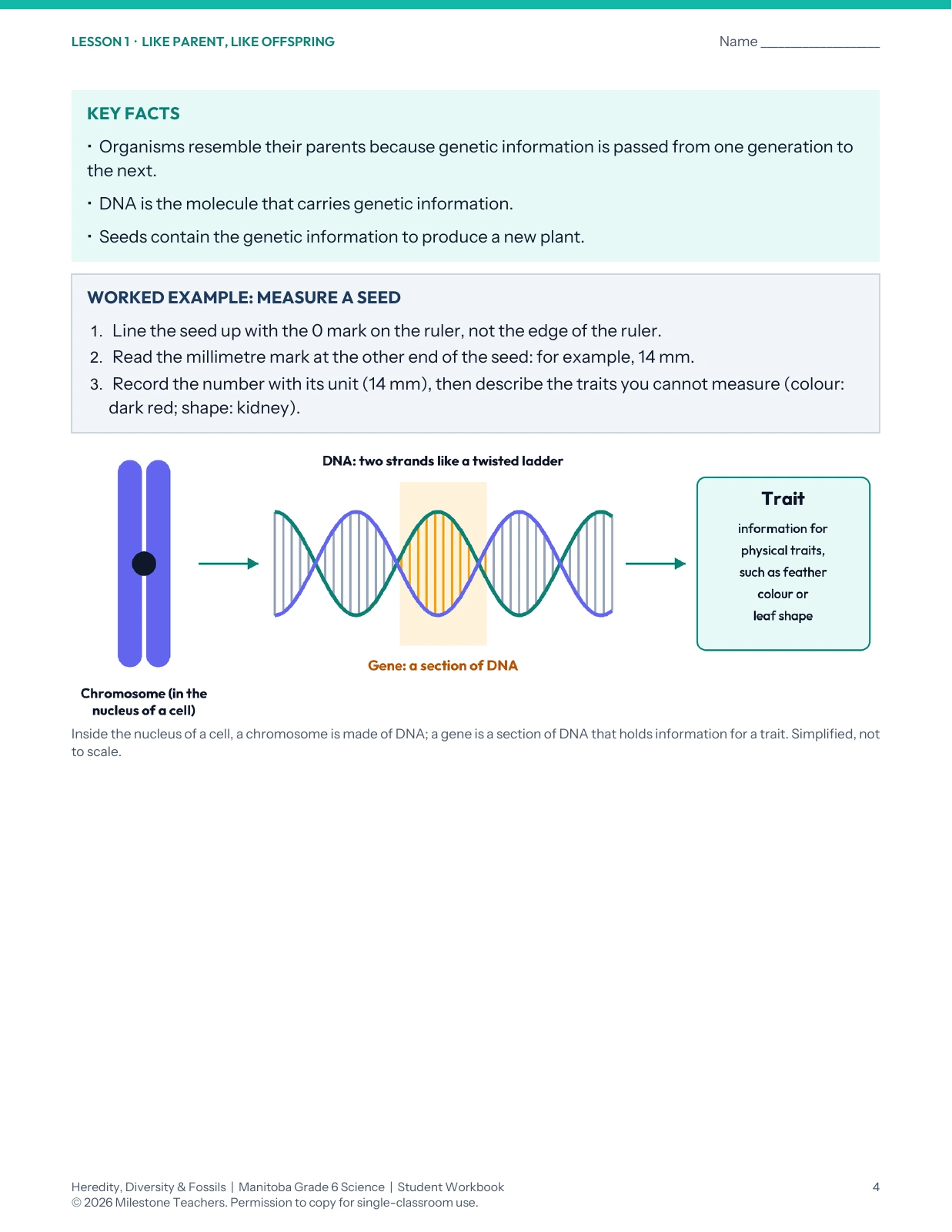
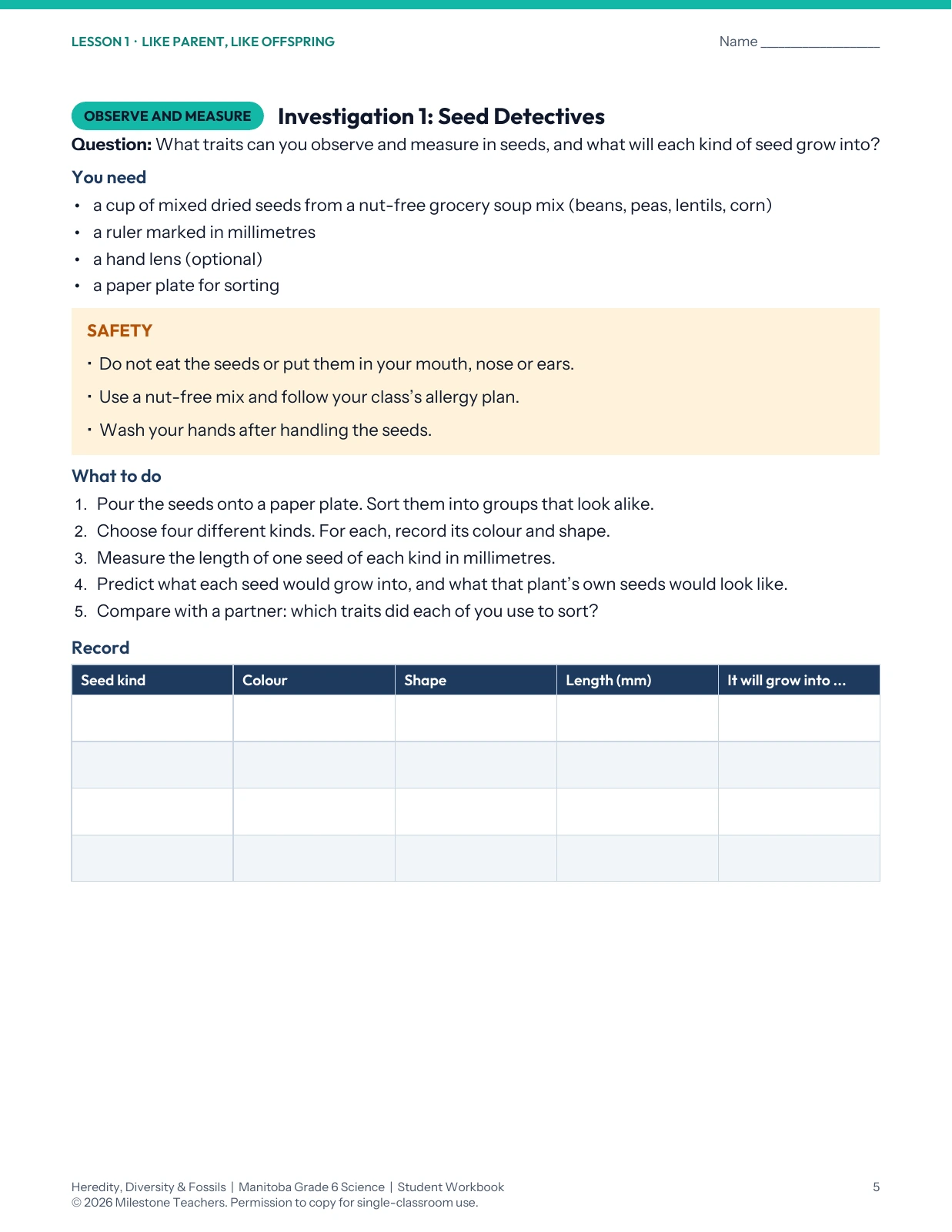
Teach inherited traits, genes and environment, classification, species, reproduction and Manitoba fossils through ten Grade 6 science lessons. The ZIP includes a 74-page student workbook, a 94-page accommodated workbook, a 39-page teacher guide with answer keys and a one-page start guide, plus teaching slides and an offline classification and fossils lab. The sample shows seed measurement and the Seed Detectives recording sheet. Targets SCI.6.E.12-E.17 with connections to the other science strands. Created by an Ontario Certified Teacher; not reviewed or endorsed by Manitoba Education.
$21.21
The licence included with each resource governs classroom use and sharing. Purchase terms cover payment and download access.
Included files
- MB6-Heredity-Diversity-Fossils-Unit.zip
Check the current product availability and price before paying through Stripe. Private downloads follow payment confirmation.
Resource licence and purchase terms · Browse resources
Look inside
Selected pages from this resource.
360° teaching & learning profile
A planning view of the current 10-lesson Heredity, Diversity & Fossils unit. It moves from parent-offspring resemblance and traits to classification, species, reproduction and fossils. Keep the science goal visible while selecting reading, pacing and response supports.
Learning goals
- Use observations and evidence to explain resemblance and variation without treating one example as a rule for every organism.
- Classify organisms with observable traits, then build, test and revise a dichotomous key.
- Use fossil and rock-layer evidence to support a claim about life in the past.
- Explain the species and hybrid examples with the unit's viable-offspring criterion.
- Distinguish a model, observation and scientific conclusion in a short explanation.
Starting points
- Check that learners can record an observation in a table and compare two examples before the seed and classification tasks.
- Clarify the everyday meanings of trait, inherited, learned, species, fossil and evidence before using them in an explanation.
- Model a two-choice decision before asking learners to read or create a dichotomous key.
Curriculum connection
Manitoba Grade 6 Science framework
- SCI.6.E.12: Offspring resemble their parents because genetic information passes between generations.
- SCI.6.E.13: Traits, skills and behaviours can result from genetic, environmental, social and learned components.
- SCI.6.E.14: Classify organisms by observable traits and use a dichotomous key.
- SCI.6.E.15: Use fossils as evidence of how organisms have changed over time.
- SCI.6.E.16: Use the idea of viable offspring to investigate species and hybrids.
- SCI.6.E.17: Sexual reproduction produces offspring that are similar to, but not identical with, their parents.
Planning summaries of the listed outcomes, not official wording or ministry endorsement. The resource connects other science strands; it is not a complete Grade 6 science course.
Differentiation
Accommodated route
Keep the lesson sequence and target visible while reducing reading and response load.
Included: A 94-page accommodated workbook accompanies the 74-page standard workbook. The lesson source uses simpler same-order readings; marked questions can provide word banks and sentence starters while keeping their original IDs.
Suggested teacher move: Choose the accommodated edition when it helps a learner access the same current idea. Read one section and its diagram together, model one response, and record any changed assessment conditions.
Classification scaffold
Make the first two-choice decision visible before a learner independently constructs a full key.
Included: Lesson 4 includes a classification-ladder activity.
Suggested teacher move: The teacher guide recommends giving the accommodated group a ladder with the first two splits drawn. When that support is useful, prepare and model the partial ladder, then ask partners to explain why a trait is useful before adding a branch.
Optional lab route
Rehearse selected classification and fossil ideas with a public interactive before, during or after the related lesson.
Included: Version 1.1 includes an offline copy of the Classify & Fossils Lab. Its optional panels occur in Lessons 4, 5, 9, 10 and the Performance Task.
Suggested teacher move: Use the Lab only when it advances the present objective; return to the workbook, teacher guide and assessment evidence rather than treating the Lab as the whole unit.
Universal Design for Learning
Engagement
Included: Seed observation, classification, key-testing and fossil investigations give learners concrete entry points to the same science questions.
Suggested teacher move: State the lesson's evidence goal before choosing a context or partner role, then use the exit task to select one focused next step.
Representation
Included: The package includes standard and accommodated workbooks, slides, a teacher guide, diagrams, word banks and sentence starters where marked in the lesson source.
Suggested teacher move: Pair the spoken explanation with the same vocabulary, diagram or model. Check the source material on the intended device; this profile does not certify accessibility or assistive-technology performance.
Action and expression
Included: Learners can record observations, draw a classification ladder, walk a key, construct and revise a key, and complete short assessment responses.
Suggested teacher move: When handwriting or reading fluency is not the science target, accept an oral explanation, labelled drawing or scribed response while assessing the same criterion and documenting changed conditions.
Assessment and next steps
Can the learner use an observation as evidence rather than making a broad claim from one example? Return to the seed table or one worked example. Ask the learner to name the observation, then the conclusion it supports.
Does the dichotomous key give two clear choices, reach one organism at each ending, and improve after testing? Use the Lesson 4 ladder or Lesson 5 worked key to model one split. Have a partner identify the first confusing step before revising.
Does the fossil explanation use the order of layers or the type of fossil as evidence, rather than an unsupported guess? Revisit one Lesson 9 layer example, label oldest and youngest, then ask for one observation and one claim.
Planning notes
- The resource is not reviewed, approved or endorsed by Manitoba Education and Early Childhood Learning.
- The accommodated edition is a classroom support, not an individual education plan, diagnostic assessment or guarantee of accessibility.
- This profile is planning information, not certified curriculum alignment or a promise of screen-reader, assistive-technology, print or interactive performance.
- The Classify & Fossils Lab directly supports SCI.6.E.14 and SCI.6.E.15. It supplements selected lessons and does not independently teach all six unit outcomes.
- Use the teacher guide's safety and local-context directions for materials, observations and discussions.
Open the Classify & Fossils Lab: Use the public Lab to rehearse a dichotomous key and fossil-layer evidence for selected Lessons 4, 5, 9, 10 and the Performance Task. The current unit archive includes an offline copy.
Continue your planning
- Manitoba Grade 6 Science Full Year Bundle
Plan all three scientific-knowledge groups with the three-unit bundle.
- Manitoba Grade 6 Science NEW Curriculum | FREE Year Plan + Seasons Lesson
Try the free year plan and seasons lesson before choosing complete teaching resources.