Fraction Detectives: Compare Fractions Mystery | Virginia Grade 4 Math
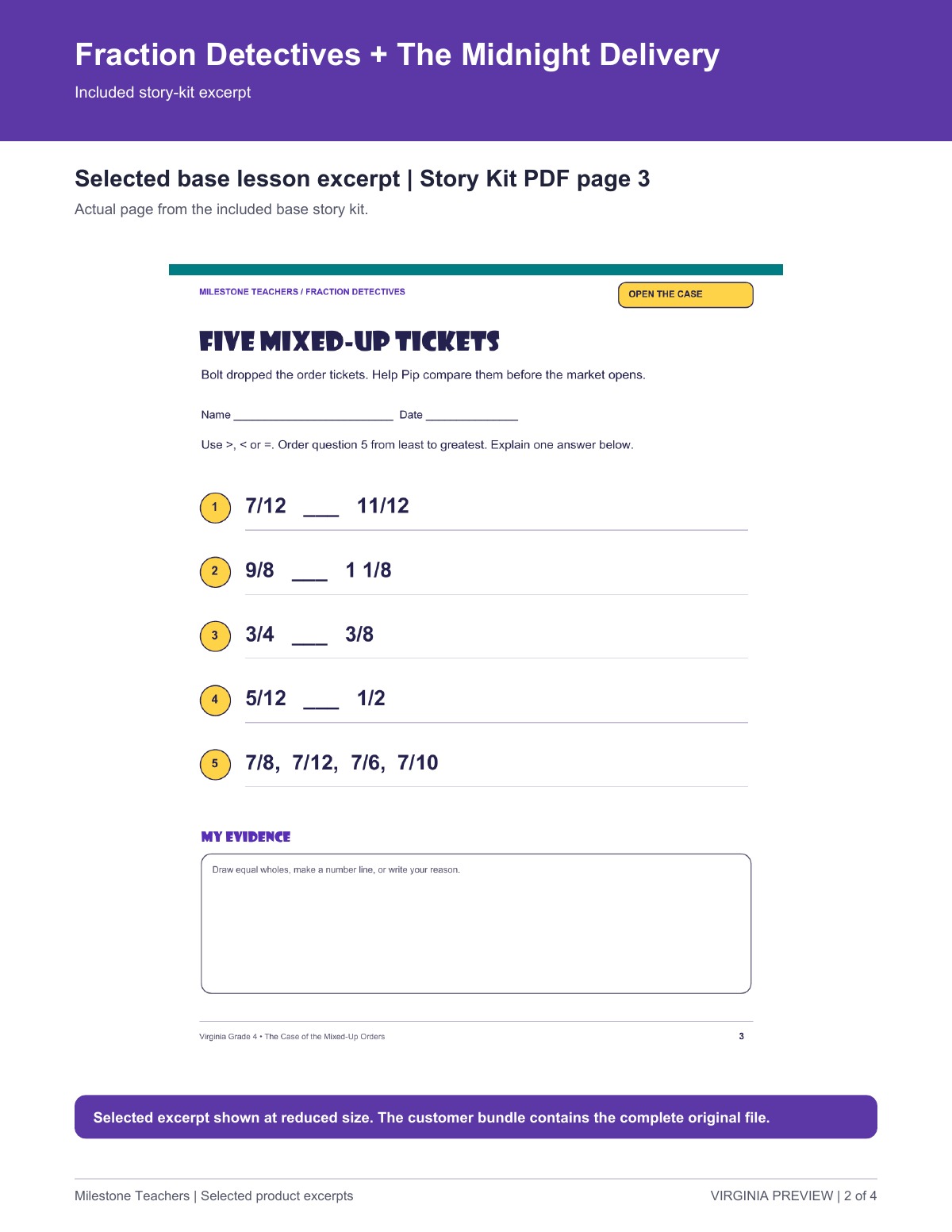
Guide Grade 4 learners through a fraction mystery with Pip and Bolt. Students compare equal-sized wholes, explain their reasoning with models, and continue with The Midnight Delivery. Includes a 16-page story kit, 5 matching low-ink student pages, 4 projection screens, a 14-slide editable branching mission, and an optional five-mission offline browser companion. The Google Slides import route requires a Google account and internet; the teacher tracks paper tickets and the mission does not automatically score or unlock. Supports selected Virginia 2023 SOL 4.NS.3a-d fraction comparison and ordering practice. It is not a complete unit, official resource, or validated assessment.
USD $4.95
Single-teacher licence for use with the purchasing teacher’s own students. Wider staff or school use requires separate permission.
Included files
- Fraction-Detectives-Customer-Edition.zip
Instant download after checkout · Refund for a missing file, duplicate purchase, incorrect charge, or a resource that does not match its description · Made by an Ontario Certified Teacher
Resource licence and purchase terms · Browse resources
Look inside
Selected pages from this resource.
360° teaching & learning profile
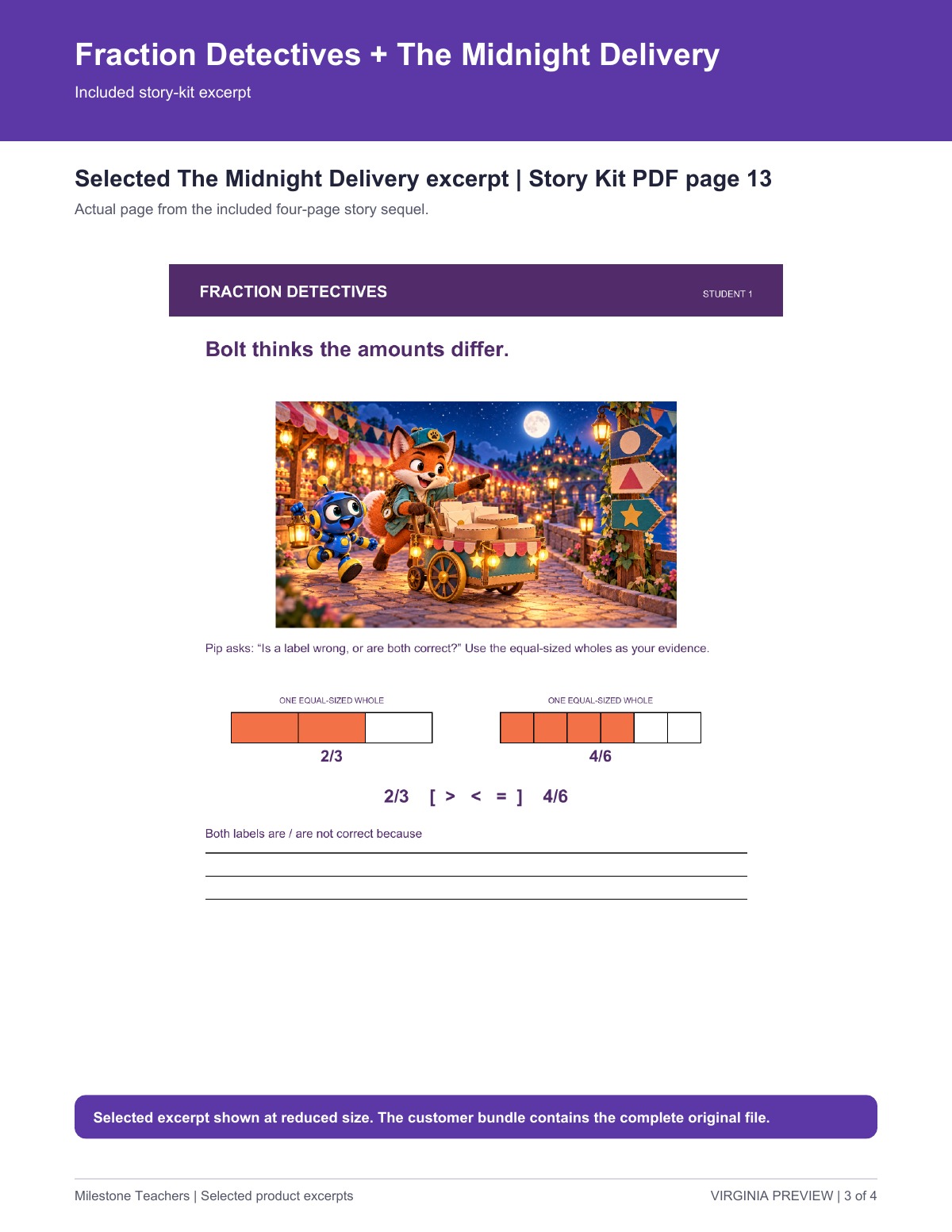
A short fraction-comparison mystery for teacher-led discussion, modeling, and formative evidence. Students compare fractions with equal wholes and justify a claim using a model, number line, or explanation.
Learning goals
- Compare fractions only after establishing equal-sized wholes.
- Use a model, number line, benchmark, or numerator and denominator relationship to justify a comparison.
- Recognize when a fraction is beyond one whole.
Starting points
- Read fraction notation and comparison symbols.
- Participate in a teacher-led discussion about equal-sized wholes.
Curriculum connection
Mathematics Standards of Learning (2023)
- 4.NS.3: Selected comparison, ordering, equivalence, benchmark, and improper-fraction opportunities with denominators of 12 or less, using models.
The kit supports selected comparison, benchmark, and equivalence opportunities within 4.NS.3; it does not cover the full outcome. Teachers should confirm local scope and sequence.
Differentiation
Print route
Work through the visual lesson and matching student pages.
Included: 01-Story-Kit.pdf and 02-Low-Ink.pdf provide the named lesson and matching print pages.
Suggested teacher move: Reveal one comparison at a time and ask which equal whole the model represents.
Projection route
Discuss a clue together before the class sees a reveal.
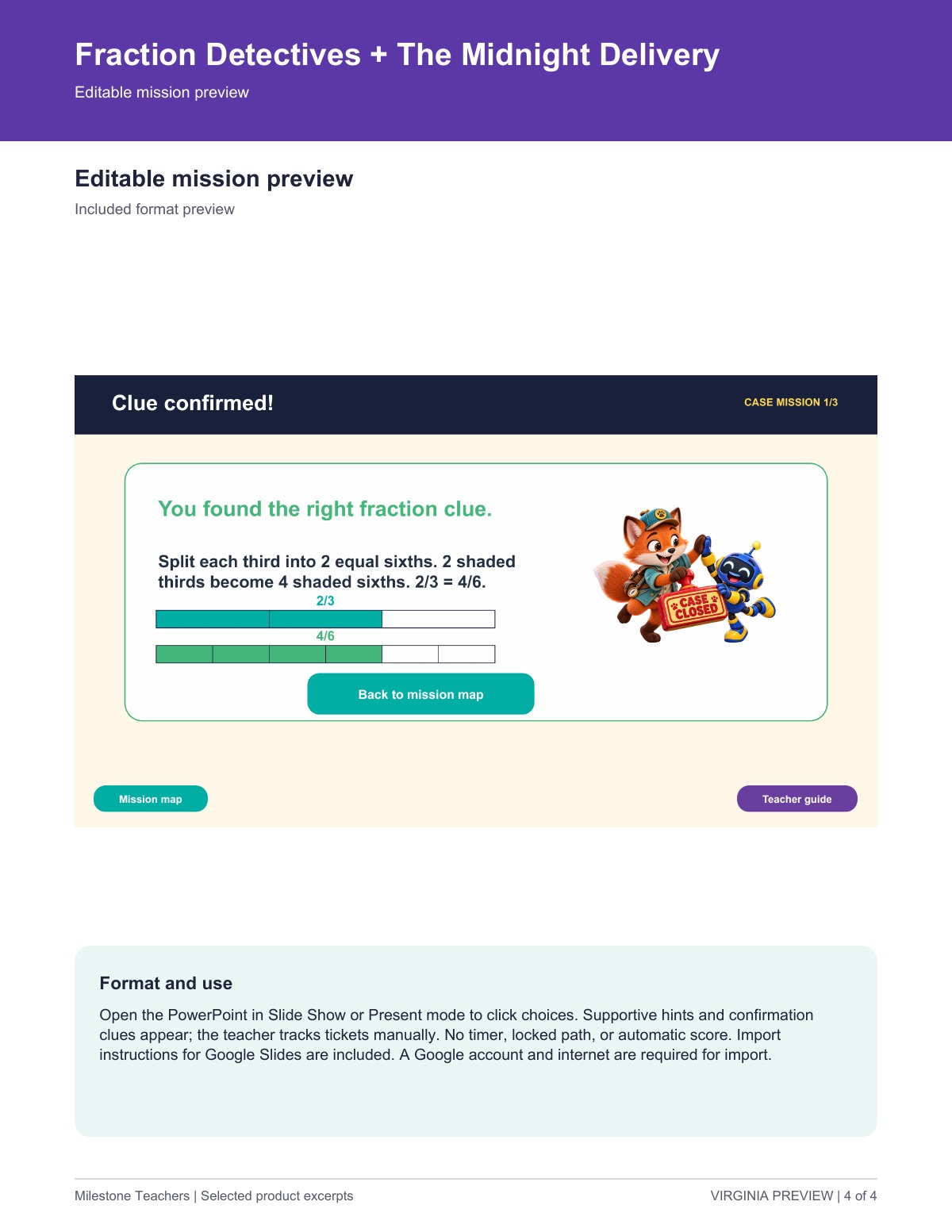
Included: 03-Classroom-Mission.pdf has four Case Theatre screens; 04-Editable-Mission.pptx is an editable branching class mission.
Suggested teacher move: Pause before each reveal and have students state a comparison claim with evidence.
Offline route
Offer a local comparison prompt when a browser file is suitable for class use.
Included: 05-Offline-Bonus/fraction-detectives.html offers local missions with oral, paper, or pointing responses and no saved responses.
Suggested teacher move: Use the local prompt as a discussion cue, then record only a teacher observation or paper response.
Universal Design for Learning
Engagement
Included: The story and selectable clue routes give a shared purpose for comparison work.
Suggested teacher move: Let students choose a visible route while keeping the same comparison-and-justification target.
Representation
Included: The kit pairs symbols with equal-whole models, number lines, and classroom screens.
Suggested teacher move: Point to the whole first, then connect the visual model to the fraction notation.
Action and expression
Included: The guides permit pointing, drawing, speaking, or writing before a written explanation.
Suggested teacher move: Accept an oral, drawn, or scribed reason, then ask every student to connect it to a model or claim.
Assessment and next steps
A student uses a comparison symbol and identifies equal-sized wholes. If the whole is unclear, show two equal wholes and ask the student to locate the compared parts before choosing a symbol.
A student supports a claim with a model, number line, benchmark, or shared numerator or denominator reasoning. If the symbol is correct without a reason, request one concrete representation rather than another set of items.
A student distinguishes a fraction beyond one whole from a fraction below one whole. Mark one whole on a number line and ask where each amount belongs before comparing.
Planning notes
- This profile is teacher-planning support, not a full curriculum alignment or validated assessment.
- The editable mission has no timer, student-data collection, automatic scoring, locked path, or required order.
- The offline bonus has no saved or scored responses; if local HTML is unavailable, the PDFs provide the core route.
- Google Slides import is optional and requires a Google account and internet.