Plant Detectives: The Case of the Tall Seedling | NSW Stage 2 Fair Tests
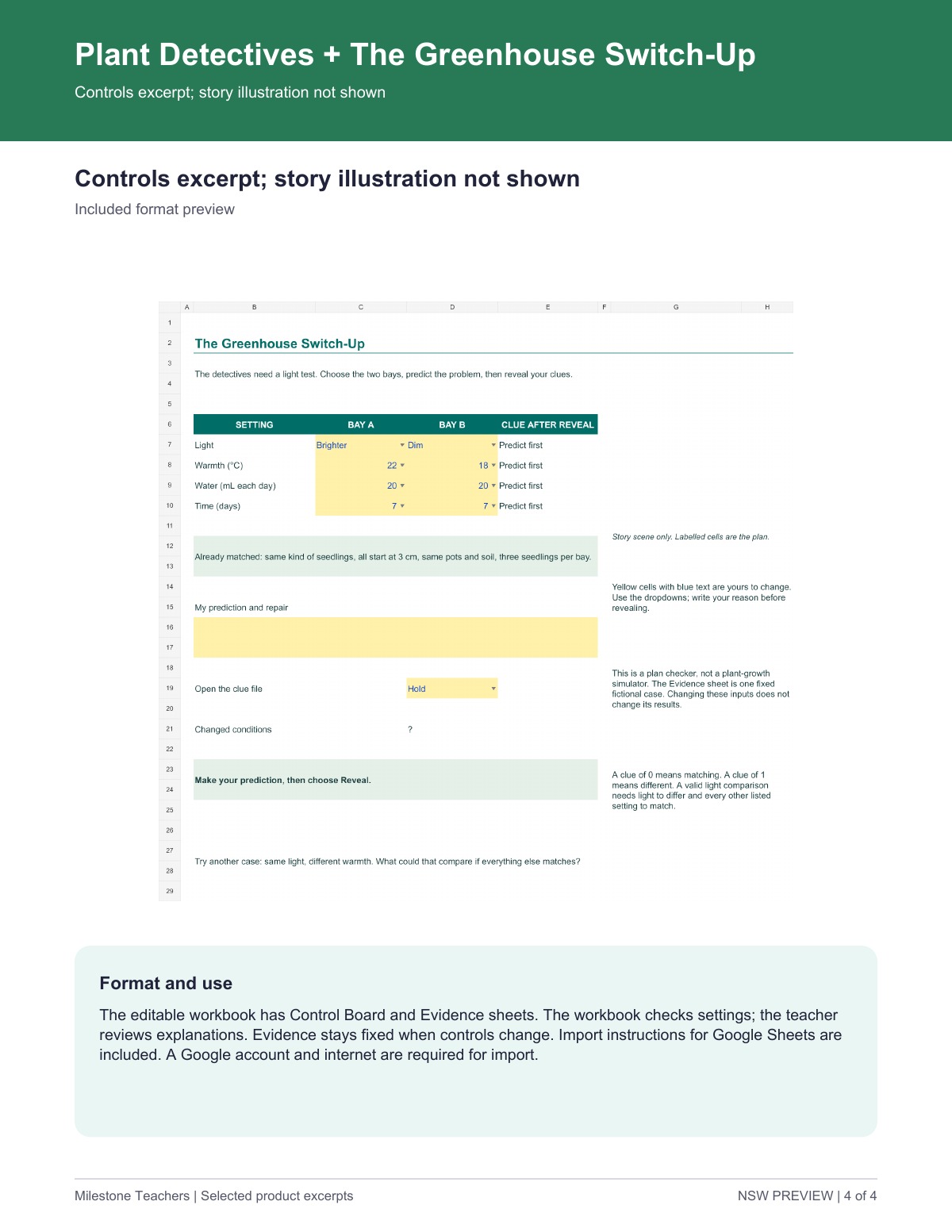
Guide Stage 2 learners through a fair-test mystery: spot an extra changed condition, repair the plan, and explain a careful verdict using more than one clue. Includes a 20-page story kit, 11 matching low-ink student/support pages, 4 projection screens, and a two-sheet editable Control Board with fixed fictional evidence. The optional Google Sheets import route requires a Google account and internet. The workbook checks listed plan differences; it does not simulate plant growth, score written explanations, or change the fixed chart and fictional observations. Taller does not necessarily mean healthier. Supports selected NSW Science and Technology K-6 Syllabus (2024) Stage 2 learning, implemented from 2027; it is not a complete program, official resource, or validated assessment.
USD $5.95
Single-teacher licence for use with the purchasing teacher’s own students. Wider staff or school use requires separate permission.
Included files
- Plant-Detectives-Customer-Edition.zip
Instant download after checkout · Refund for a missing file, duplicate purchase, incorrect charge, or a resource that does not match its description · Made by an Ontario Certified Teacher
Resource licence and purchase terms · Browse resources
Look inside
Selected pages from this resource.
360° teaching & learning profile
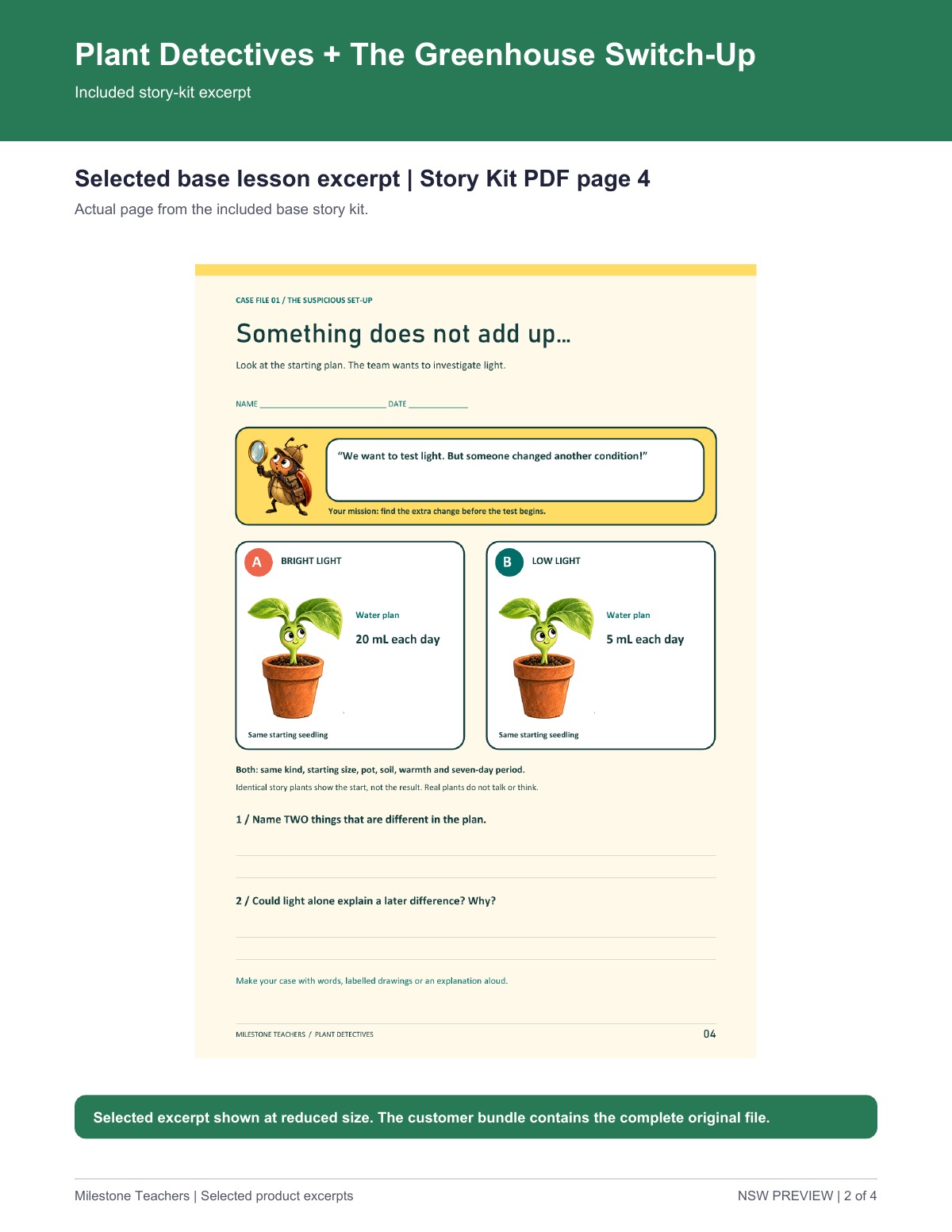
A paper-based fair-test investigation in which students identify a confound, repair a plan, and use several fictional observations to qualify a claim about a tall seedling.
Learning goals
- Identify when more than one condition changes in a proposed investigation.
- Repair a plan so one intended condition changes while relevant conditions are kept the same.
- Use more than height to evaluate a claim from fictional observations.
Starting points
- Describe a condition that changes and a condition kept the same.
- Use a ruler and simple observation words with teacher support.
Curriculum connection
Science and Technology K-6 (2024) outcomes
- ST2-PQU-01: Pose questions and create fair tests that investigate effects of energy on living things and physical systems.
The kit is a paper-based planning entry point for this outcome. NSW's 2024 K-6 site states schools prepare in 2026 and teach from 2027; confirm the school implementation calendar.
Differentiation
Paper investigation route
Use the core story, student pages, and low-ink copies without live plants.
Included: 01-Story-Kit.pdf, pp. 3-5 and 02-Low-Ink.pdf, pp. 1-2 provide the original paper investigation route.
Suggested teacher move: Read one condition row at a time and ask which condition is intended for investigation and which other condition needs review.
Projection route
Discuss the case with the whole class before a reveal.
Included: 03-Classroom-Mission.pdf contains four projection screens: setup, challenge, reveal, and fresh clue.
Suggested teacher move: Pause before each reveal and ask for a condition or observation that supports the response.
Control board route
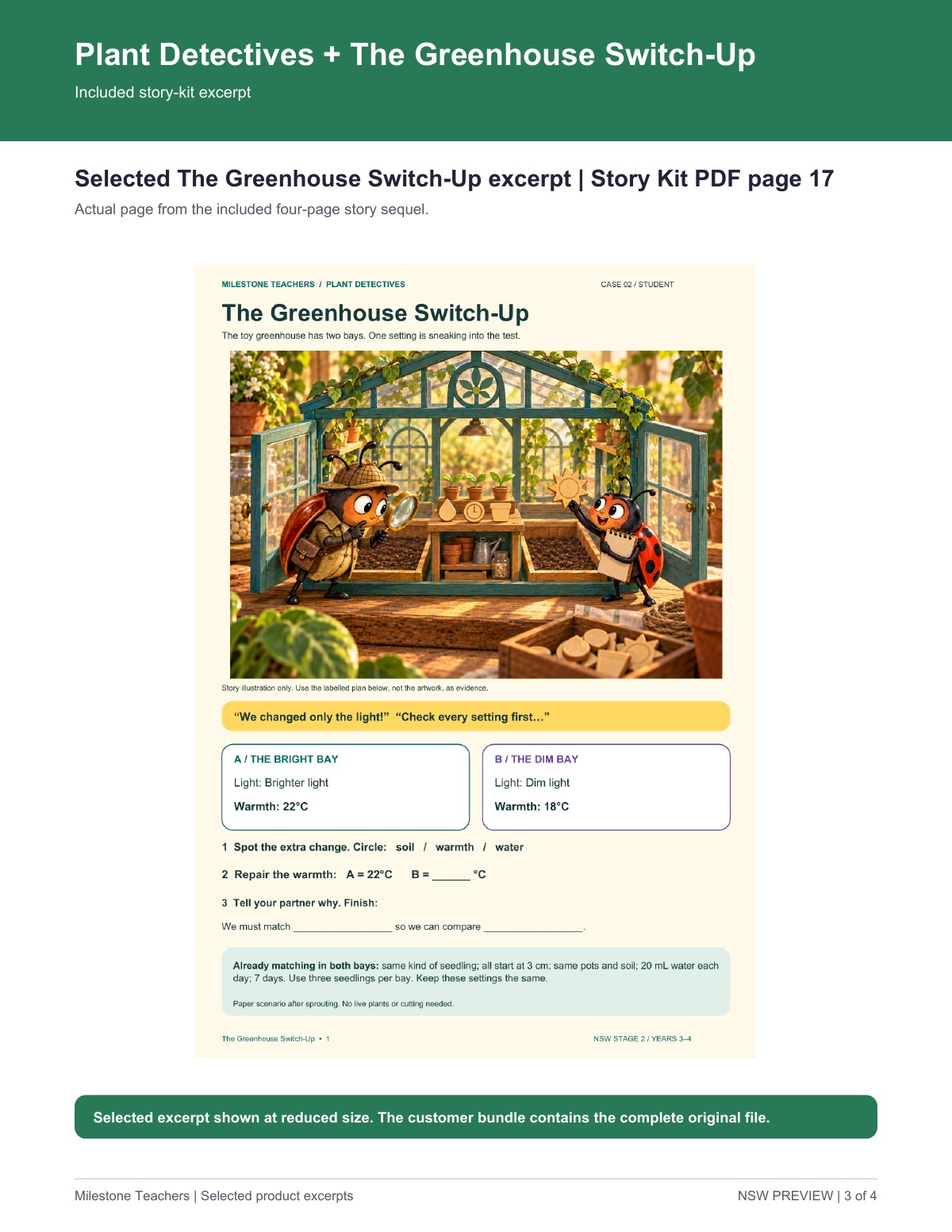
Make the Greenhouse Switch-Up sequel's planned conditions visible in a teacher-guided workbook.
Included: 01-Story-Kit.pdf, pp. 17-19; 02-Low-Ink.pdf, pp. 10-11; and 04-Greenhouse-Control-Board.xlsx provide the Greenhouse Switch-Up student route.
Suggested teacher move: Use Hold and Reveal to discuss planned conditions, then use the Evidence sheet for a qualified claim.
Universal Design for Learning
Engagement
Included: The three-case sequence gives students a visible notice, repair, and explain route.
Suggested teacher move: Set one concrete task at a time and ask partners to revise one unclear plan detail.
Representation
Included: The kit provides original and sequel condition tables, a fiction label, low-ink copies, and language support at 01-Story-Kit.pdf, p. 11 and 02-Low-Ink.pdf, p. 8.
Suggested teacher move: Use a changed/kept-the-same organizer and retain the fictional-data label while students inspect the evidence.
Action and expression
Included: The guide permits talk, labelled drawings, and scribed responses; colour meanings also appear in words or labels.
Suggested teacher move: Accept oral, drawn, or scribed evidence statements while asking each student to name a condition or observation.
Assessment and next steps
In the original route, a student identifies an intended condition and another condition that affects a fair comparison. Read the original plan one row at a time and sort conditions into same or different before revisiting the investigation question.
A student proposes a plan with one intended change and named conditions kept the same. Ask for one missing control or measurement method, then have the student revise that one detail.
A student uses at least two observations and states what the fictional record cannot establish. Ask what the height shows, what another observation shows, and what question the small record cannot answer.
Planning notes
- This profile is planning support, not a full curriculum alignment, validated assessment, or claim of learning effect.
- The original and Greenhouse Switch-Up routes use fictional evidence and do not require live plants; the workbook is not a growth simulator.
- The workbook's evidence table and chart are fixed; changing controls does not change the observations.
- The workbook checks planned differences, not explanations or real plant health; optional Google Sheets import requires a Google account and internet.