Manitoba Grade 5 Cells & Body Systems Unit
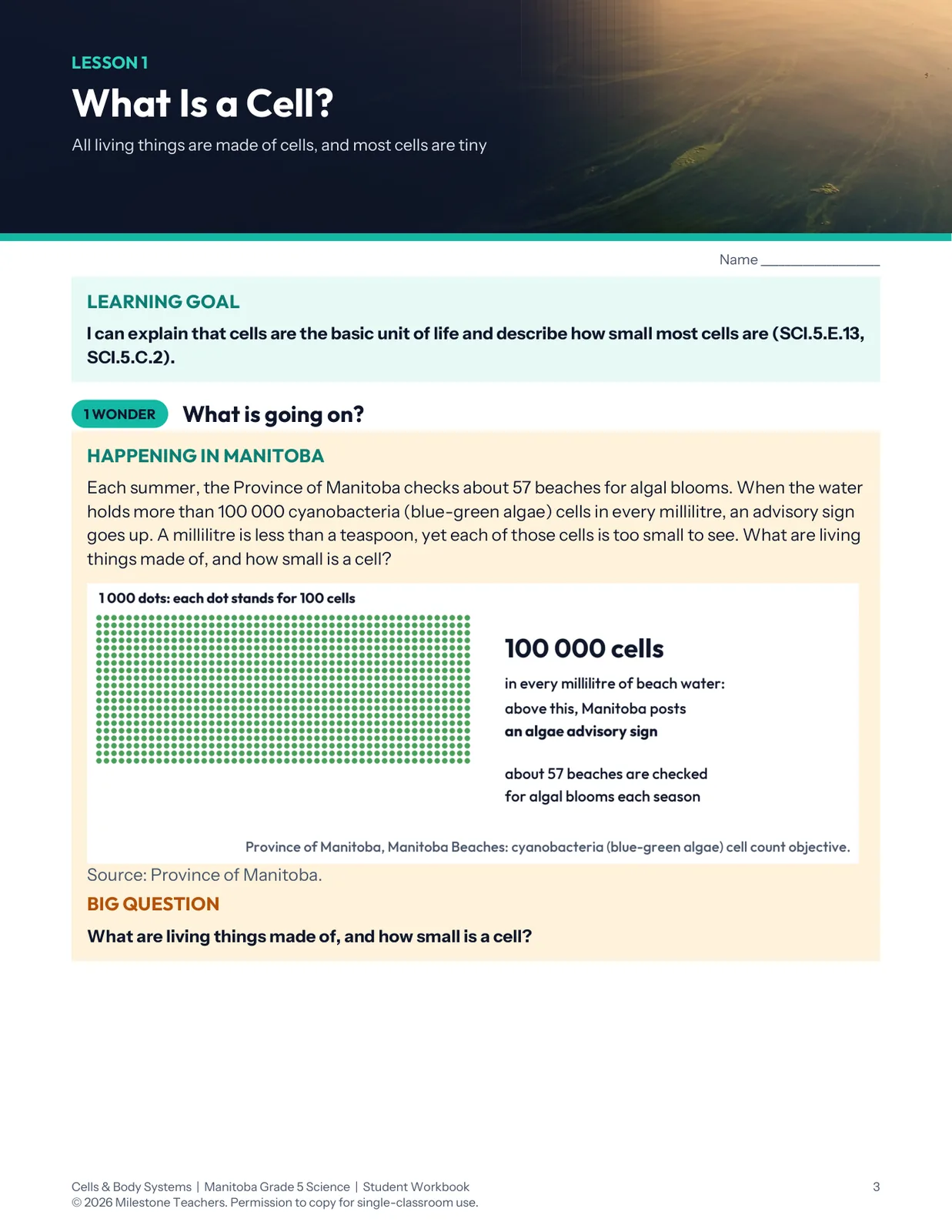
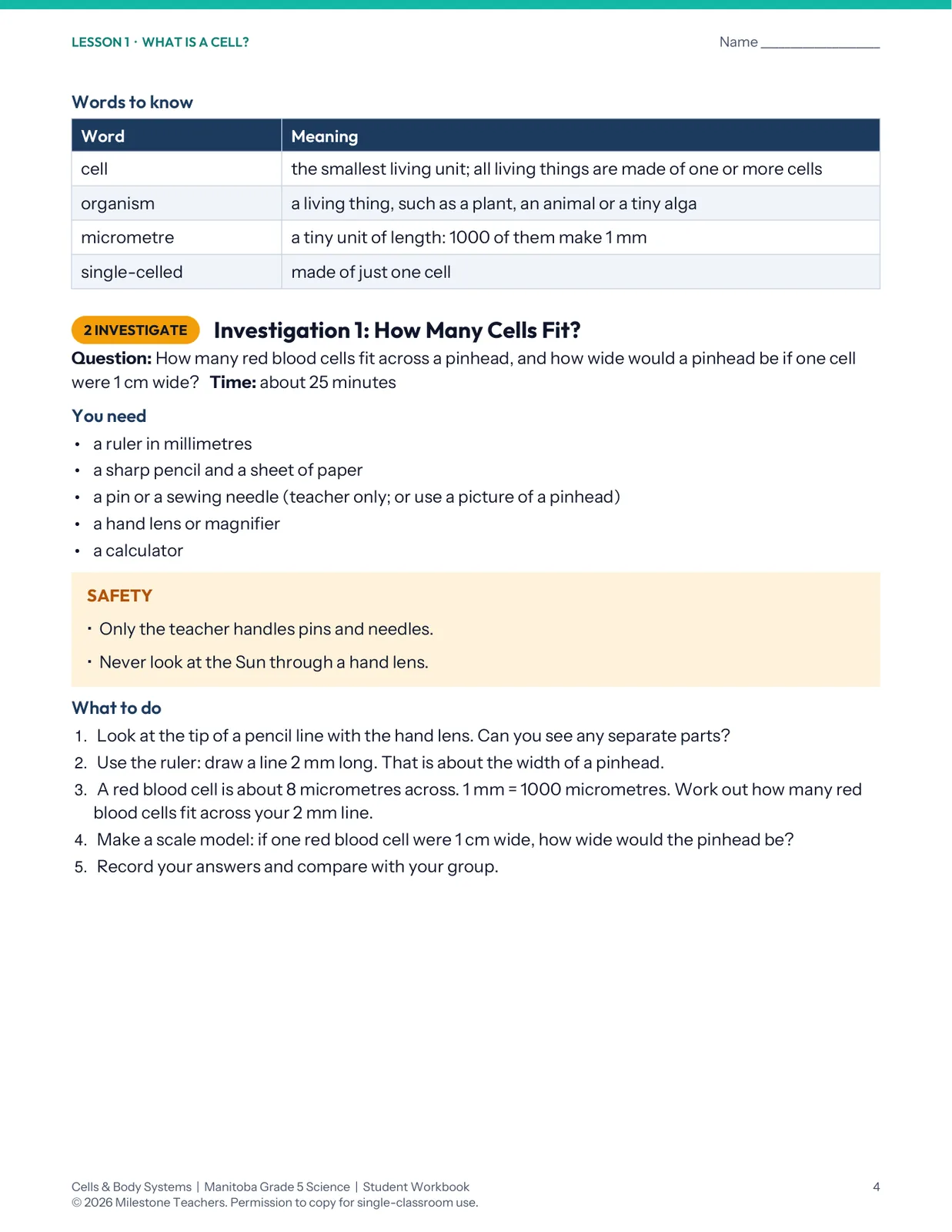
Teach the cells and body systems outcomes of Manitoba's renewed Grade 5 Science (SCI.5.E.13 to E.17) through ten inquiry lessons: what a cell is and how small cells are, seeing cells with microscopes, what cells need, how cells make more cells, tissues, organs and organ systems, digestion, circulation, removing wastes and how the systems work together, ending with a Body Systems Field Guide. The ZIP holds 76 editable PowerPoint slides with speaker notes, an 11-slide editable response deck, a 74-page student workbook, an 85-page accommodated edition with the same question numbers and answer key, a 36-page teacher guide with answer keys and a rubric on Manitoba's report-card scale, and a one-page START HERE guide. The sample shows Lesson 1's Manitoba beach-monitoring data and the How Many Cells Fit? investigation. Limits: it covers the cells and body systems outcomes only and has no classroom interactive; it is science teaching, not health advice; a microscope helps in Lesson 2 (with only a hand lens, cell outlines are faint). Written by an Ontario Certified Teacher; not reviewed or endorsed by Manitoba Education and Early Childhood Learning.
USD $14.95
The licence included with each resource governs classroom use and sharing. Purchase terms cover payment and download access.
Included files
- MB5-Cells-Unit.zip
Instant download after checkout · Refund for a missing file, duplicate purchase, incorrect charge, or a resource that does not match its description · Made by an Ontario Certified Teacher
Resource licence and purchase terms · Browse resources
Look inside
Selected pages from this resource.
Continue your planning
- Manitoba Grade 5 Science Full Year Bundle
Plan the whole Grade 5 year with the four-unit bundle.
- Manitoba Grade 5 Forces & Simple Machines Unit
Teach Forces & Simple Machines (SCI.5.E.5 to E.8) as a separate unit.
- Manitoba Grade 5 Matter & Its Changes Unit
Teach Matter & Its Changes (SCI.5.E.1 to E.4) as a separate unit.
- Manitoba Grade 5 Weather & Climate Unit
Teach Weather & Climate (SCI.5.E.9 to E.12) as a separate unit.