Manitoba Grade 4 Habitats & Food Webs | 10-Lesson Science Unit
Teach habitats, adaptations, food chains, food webs, decomposers, pollination and seed dispersal through ten Manitoba Grade 4 science lessons. Students survey the schoolyard, compare beak tools, test camouflage and insulation, build a yarn web and plan an action to protect a vulnerable link. One website-edition ZIP includes 240 PDF pages: a 77-page student workbook, 92-page accommodated workbook, 70-page Teacher Guide with keys, rubrics and slide-by-slide teaching prompts, and a one-page START HERE guide. It also includes 81 editable teaching slides and 31 editable response-sheet slides. PowerPoint software is not included. Covers SCI.4.E.13 to E.15 with selected supporting B–D outcomes. Limits: not a full-year course; does not teach SCI.4.A.1. The named Key First Nation source example is from Saskatchewan. Investigations need the listed materials and teacher preparation; decomposition bags stay sealed. The free online Habitat Web Lab is separate, with no offline interactive in the ZIP. Written by an Ontario Certified Teacher; not reviewed or endorsed by Manitoba Education and Early Childhood Learning.
USD $14.95
One educator may use these files with their own students. Additional teachers need their own licences. Do not resell or publicly post the files. Downloads are available for 12 months after payment; downloaded files remain licensed for this use.
Included files
- MB4-Habitats-Food-Webs-Website-Edition.zip
Instant download after checkout · Refund for a missing file, duplicate purchase, incorrect charge, or a resource that does not match its description · Made by an Ontario Certified Teacher
Resource licence and purchase terms · Browse resources
Look inside
Selected pages from this resource.
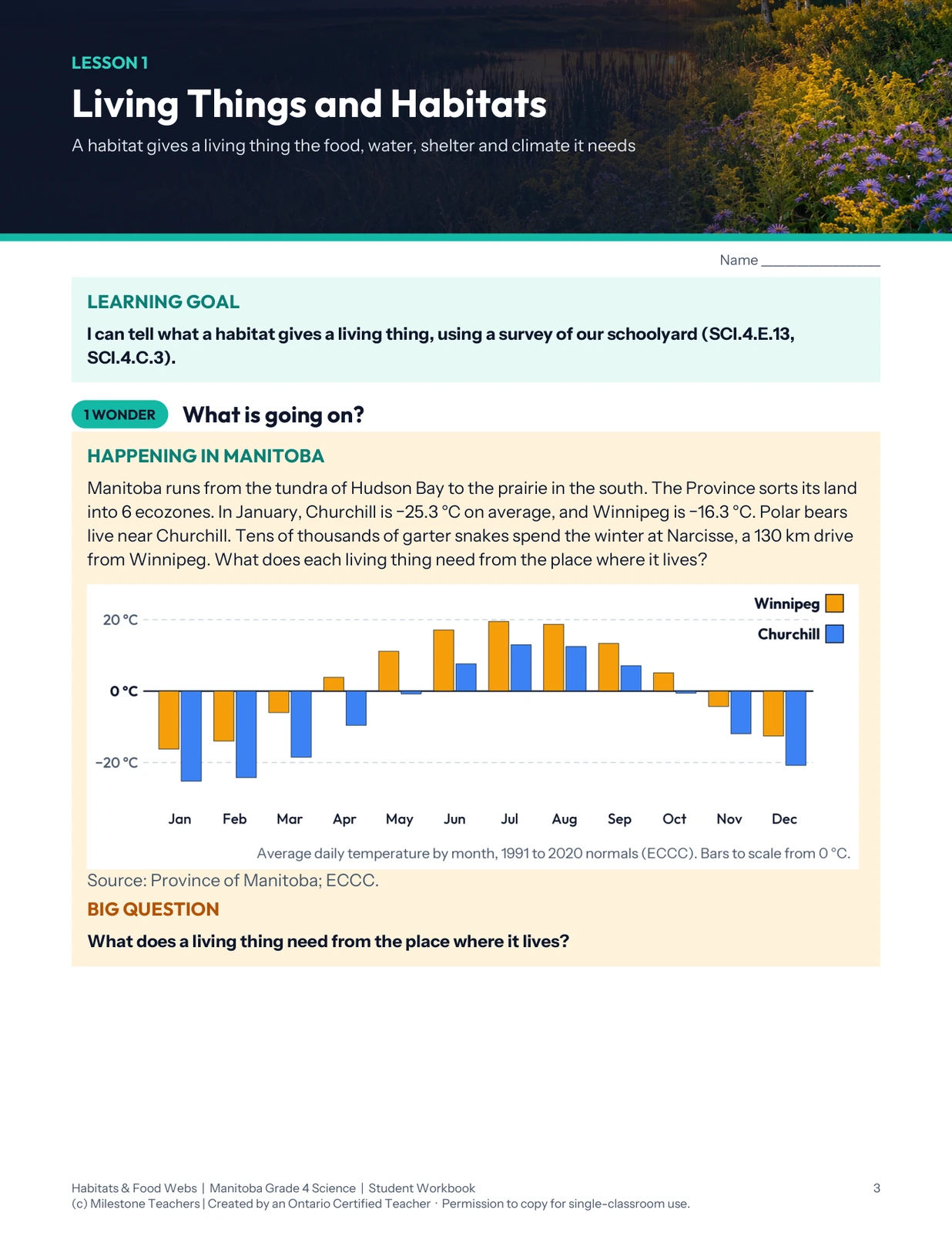
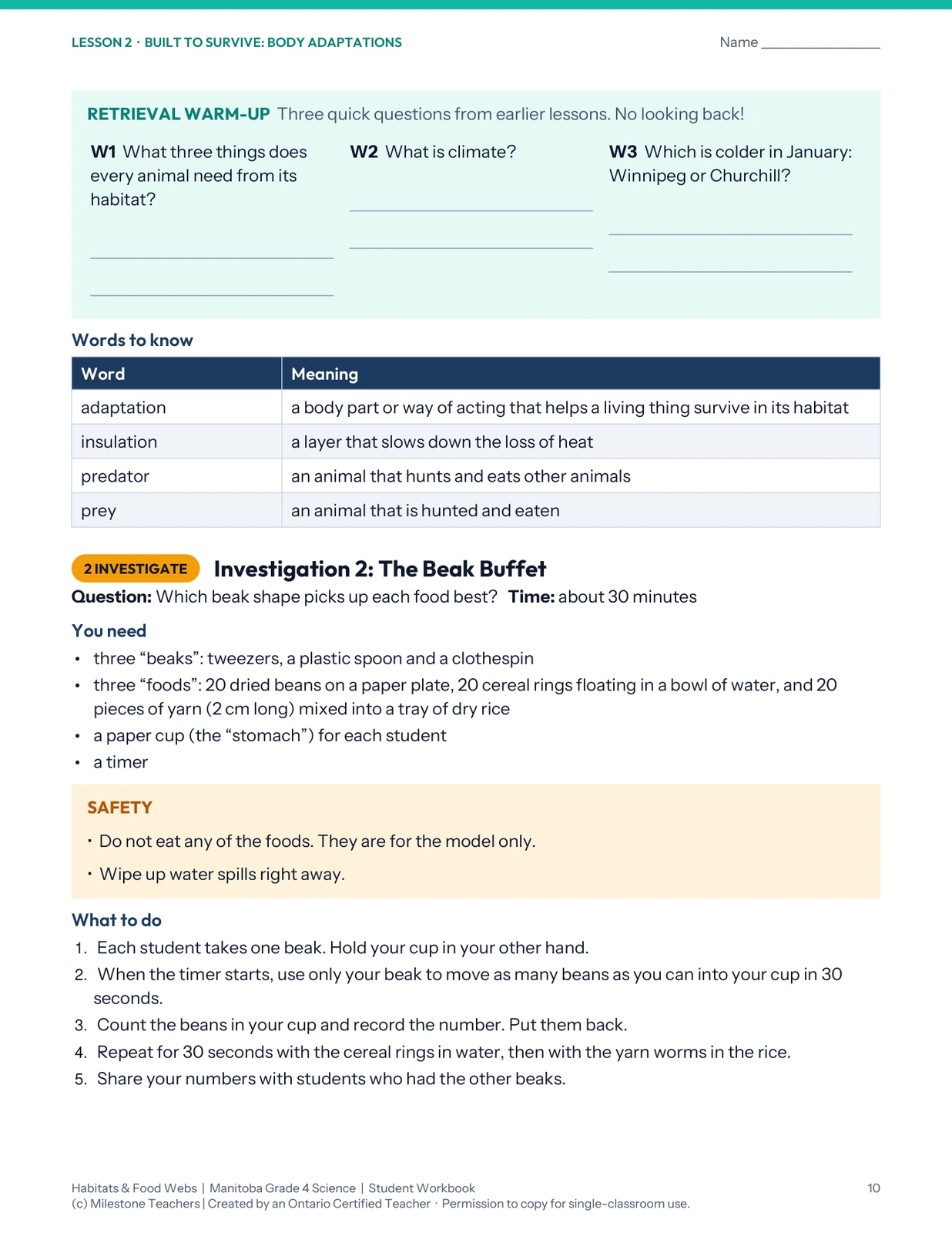
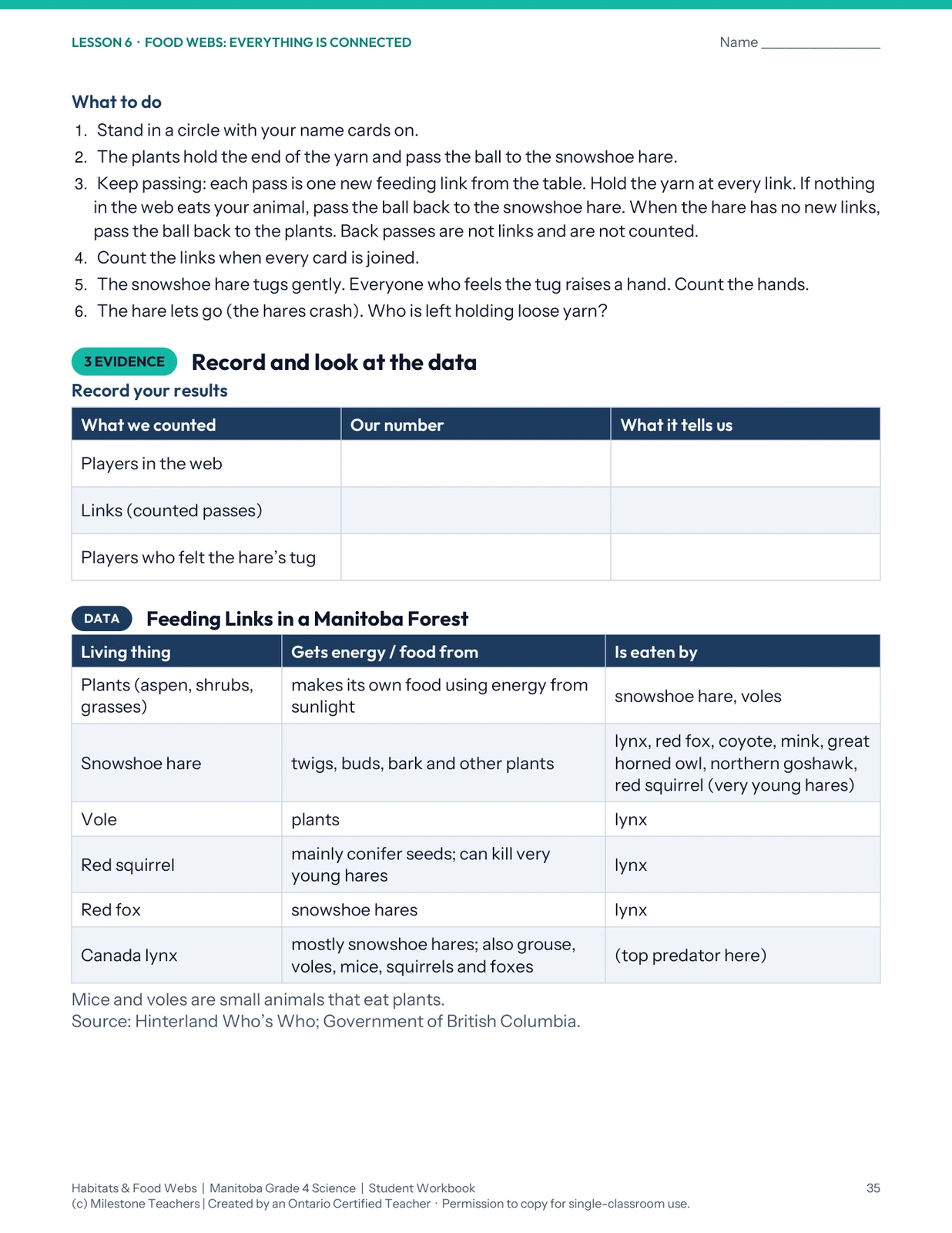
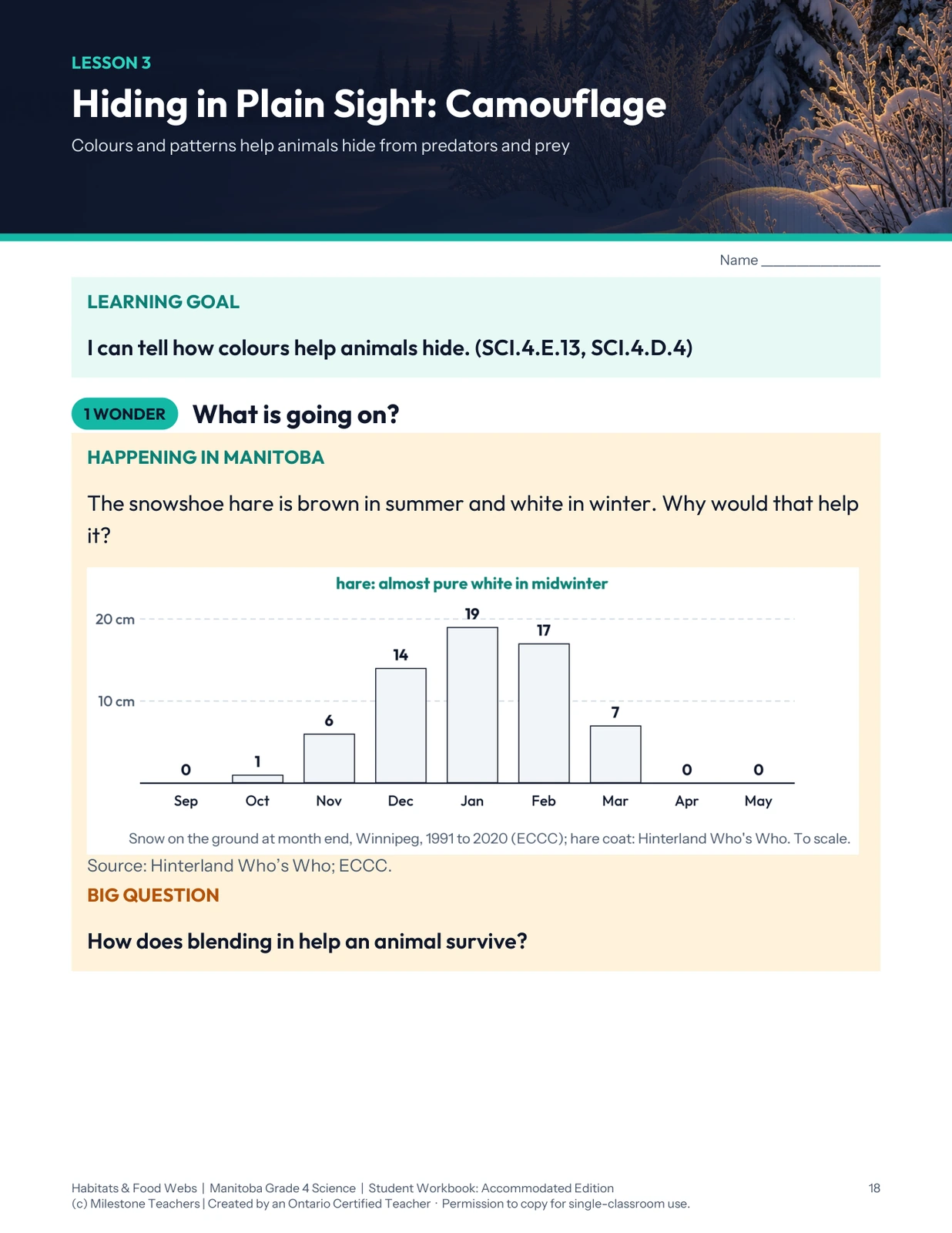
360° teaching & learning profile
Ten lessons move from a schoolyard survey to a plan for protecting a vulnerable food-web link. Students investigate, record evidence and explain patterns. Choose the standard or accommodated workbook for the same science goals.
Learning goals
- Use observations to explain what a habitat provides and how an organism survives there.
- Follow energy through a food web and distinguish energy flow from matter cycling.
- Use evidence to explain interdependence and plan an action to protect a vulnerable link.
Starting points
- Ask students to name one living thing and what it needs to survive.
- Check whether students read a food-chain arrow as the direction energy moves.
- Before measuring, model the equipment, units and safe handling needed for that investigation.
Curriculum connection
- SCI.4.E.13: Adaptations that help organisms survive in particular habitats.
- SCI.4.E.14: Matter cycling and energy flow in food chains and food webs.
- SCI.4.E.15: How plants, animals and people depend on one another and their environment.
These are plain-language summaries. The Teacher Guide maps the selected supporting B–D outcomes included in this unit and states the limits. This unit does not teach SCI.4.A.1 or the other Grade 4 Scientific Knowledge outcomes. Independent resource; not reviewed or endorsed by Manitoba Education and Early Childhood Learning.
Differentiation
Support
Reduce reading barriers while keeping the science reasoning.
Included: Accommodated workbook with shorter readings, word banks and sentence starters.
Suggested teacher move: Read the investigation together, model one observation and invite an oral explanation before writing.
Core
Connect a hands-on model or observation to an evidence-based explanation.
Included: Standard workbook, teaching slides, record sheets and lesson exit tickets.
Suggested teacher move: Ask students to point to the observation or data supporting each claim.
Stretch
Explain limits, test an alternative or consider another food-web effect.
Included: Go further prompts and the culminating Field Guide task.
Suggested teacher move: Ask what the classroom model leaves out and what additional evidence would help.
Universal Design for Learning
Engagement
Included: Local observations, Manitoba examples and hands-on investigations.
Suggested teacher move: Use the supplied winter schoolyard alternative when outdoor conditions change.
Representation
Included: Diagrams, data tables, projected slides and two workbook editions.
Suggested teacher move: Read one visual aloud and connect its labels to the same terms in the investigation.
Action and expression
Included: Printable record spaces, editable PowerPoint response sheets and sentence frames.
Suggested teacher move: Allow pointing, oral explanation or supported recording when those preserve the science goal.
Assessment and next steps
A claim connects to a recorded observation or data point. If students give an unsupported claim, return to the record and ask which observation supports it.
Students explain energy arrows, producer roles and missing-link effects. Rebuild one chain together and trace each arrow before returning to the wider web.
The proposed action identifies a vulnerable link and a way to check its effect. Narrow an overlarge plan to one action the class can carry out and observe.
Planning notes
- This is one life-systems unit, not a complete Grade 4 science year.
- Models simplify real ecosystems. Investigation examples are labelled; classroom measurements will vary.
- The Key First Nation example is explicitly from Saskatchewan. It does not stand for every Nation or teach local SCI.4.A.1.
- The accommodated edition supports access; it is not an individual education plan.
- Habitat Web Lab is free online and separate from the paid ZIP. The download includes no offline interactive.
Try Habitat Web Lab free: Build food chains, remove a web link, compare survival connections and sort pollen from seeds. No purchase or login required. This simplified online model supports selected concepts; it is not the complete unit.
Continue your planning
- Manitoba Grade 4 Science Energy in Action and Energy Sources Unit
Continue Grade 4 science with Energy in Action and Energy Sources.
- Manitoba Grade 4 Science: Light and Sound
Teach the separate Grade 4 Light and Sound outcomes.