Free interactive · Manitoba Grade 4 Science · Habitats and ecosystems
Habitat Web Lab: follow the food, then take one link out
Students build boreal, prairie and wetland food chains, then remove a hare from a web. They distinguish an animal's adaptation from habitat cover and a feeding relationship, and sort pollination and seed dispersal. It is free, runs in the browser, and needs no login or email.
Free · No login · No email · Nothing saved or sent
Milestone Teachers · Manitoba Grade 4 Science · Last reviewed
Open Habitat Web Lab (free, full screen) · Manitoba classroom science
What it is
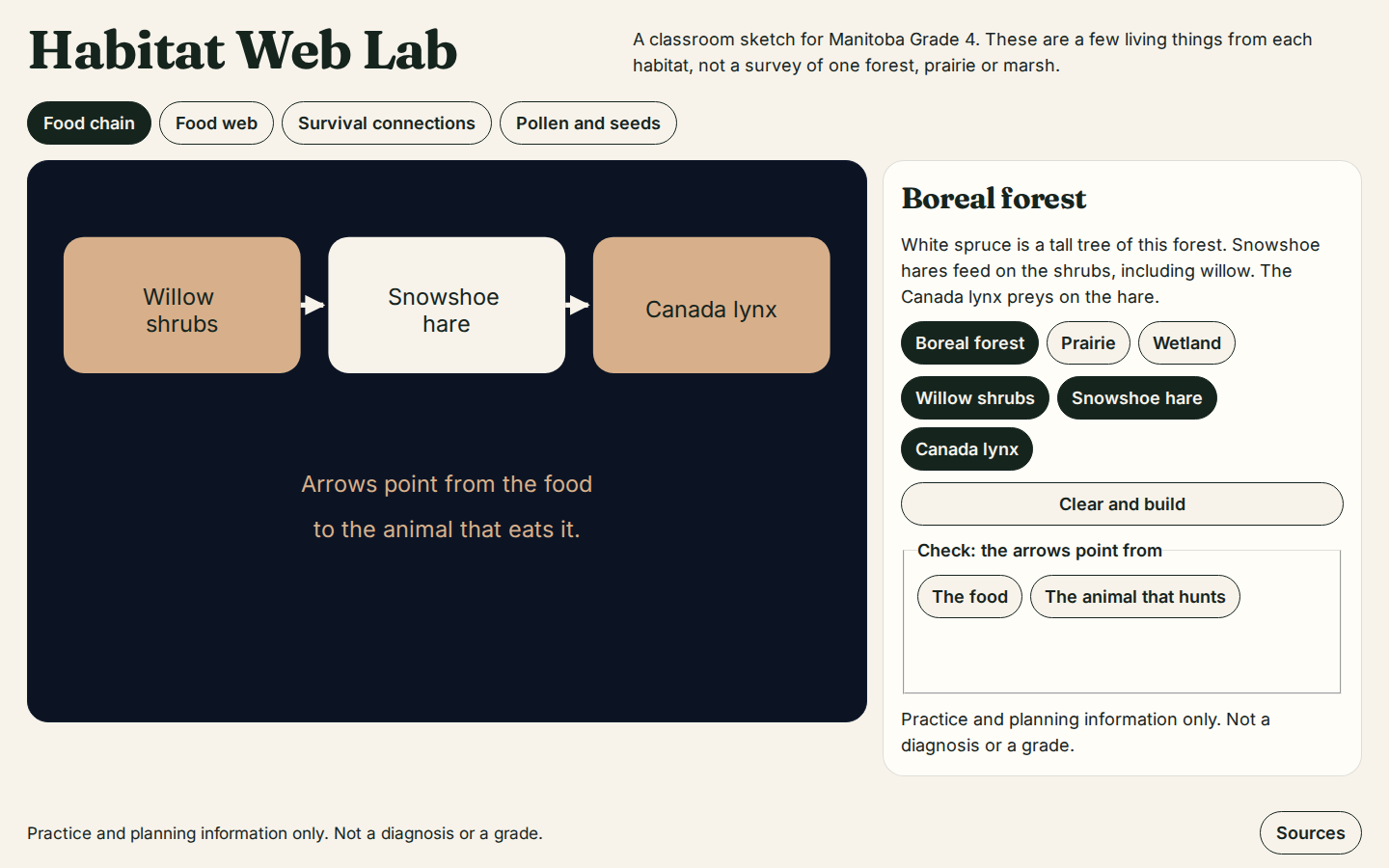
- Three Manitoba chains. Boreal shrubs, snowshoe hare and Canada lynx. Prairie big bluestem, grasshopper and western meadowlark. Wetland cattail, muskrat and mink.
- A web with a missing link. Lynx and great horned owl both eat the hare. Taking the hare out affects both hunters.
- Survival connections. Distinguish a hare's white-coat adaptation from shrub cover in its habitat and the lynx-hare feeding relationship.
- Pollen and seeds. A bee or butterfly moves pollen. A burr, a berry and cattail fluff move seeds.
- Free. No login, no email, no sign-up.
- Runs in the browser.
- Nothing a student does is saved or sent.
How to use it in class
- Read the boreal chain. The chain is already built. Switch to prairie, then wetland.
- Clear and build. Ask which living thing has to go first. The plant makes the food.
- Take the hare out. Ask who loses food. Both hunters do.
- Name the connection. Ask whether each card shows an organism adaptation, habitat cover or a feeding relationship, and ask why.
- Sort five cards. Pollination moves pollen. Seed dispersal moves the seed afterward.
Curriculum link
Partial support for selected habitat outcomes in Manitoba's renewed Grade 4 Science curriculum.
- SCI.4.E.14: Food chains and food webs.
Demonstrate an understanding of the cycling of matter and flow of energy among organisms and non-living parts of an ecosystem.
The chains and the web follow food from a plant to the animals that eat it. They do not show matter cycling or the non-living parts of an ecosystem. - SCI.4.E.13: Adaptations.
Demonstrate the understanding that every living organism has adapted to survive in a specific habitat.
The white winter coat is an organism adaptation. The other two cards distinguish habitat cover and a feeding relationship from that trait. - SCI.4.E.15: Pollination and seed dispersal.
Demonstrate an understanding of how plants and animals (including humans) rely on each other and the environment for survival.
The last cards separate pollen reaching a flower from a ride that moves a seed. Cattail pollen and seeds travel on the wind.
Contains information from the Government of Manitoba, licensed under the OpenMB Information and Data Use License (Manitoba.ca/OpenMB). OpenMB licence.
Units for this year
Habitat Web Lab is free online. The Habitats & Food Webs website edition is a separate download; the lab is not included in its ZIP.
- Manitoba Grade 4 Habitats & Food Webs | 10-Lesson Science Unit. SCI.4.E.13 to E.15: habitats and adaptations, food chains and food webs, decomposers, pollination and seed dispersal. A separate Milestone Teachers website edition. Habitat Web Lab is free online and is not included in the ZIP.
Honest limits
- Each chain leaves out many living things.
- The survival cards show one animal adaptation. Shrub cover and the lynx-hare feeding relationship are different kinds of survival connection.
- Prairie and wetland pictures are sketches, not a count of one place.
- A real lynx can eat other prey when hares are scarce. This web shows its main food.
- Partial support for SCI.4.E.13 to E.15. It does not show matter cycling or the non-living parts of an ecosystem.
- Not a diagnosis or a grade.
Credits
- Science: Canadian Wildlife Federation, Hinterland Who's Who, for the boreal food web, the Canada lynx, the snowshoe hare and its winter coat.
- Curriculum: Manitoba Education and Early Childhood Learning, renewed Grade 4 Science, partial support for SCI.4.E.13 to E.15.
- Made by: An independent teaching resource from Milestone Teachers.
Sources
Checked against the sources below on 16 October 2026.
- Manitoba Education and Early Childhood Learning: Science: Grade 4
- Canadian Wildlife Federation: Hinterland Who's Who: Boreal forest
- Canadian Wildlife Federation: Hinterland Who's Who: Canada lynx
- Canadian Wildlife Federation: Hinterland Who's Who: Snowshoe hare
All interactive labs · New curriculum guides
After the lab
Full unit on Milestone Teachers: Habitats & Food Webs.
More labs for Grade 4
- Energy Sources Lab (Science · Energy in action)
- Light and Sound Lab (Science · Light and sound)
- Rocks, Soil and Erosion (Science · Rocks, soil and erosion)
- Fraction Repair Lab (Unit fractions)