Free interactive · Manitoba Grade 4 Science · Rocks, soil and erosion
Rocks, Soil and Erosion: break the rock, then see what moves it
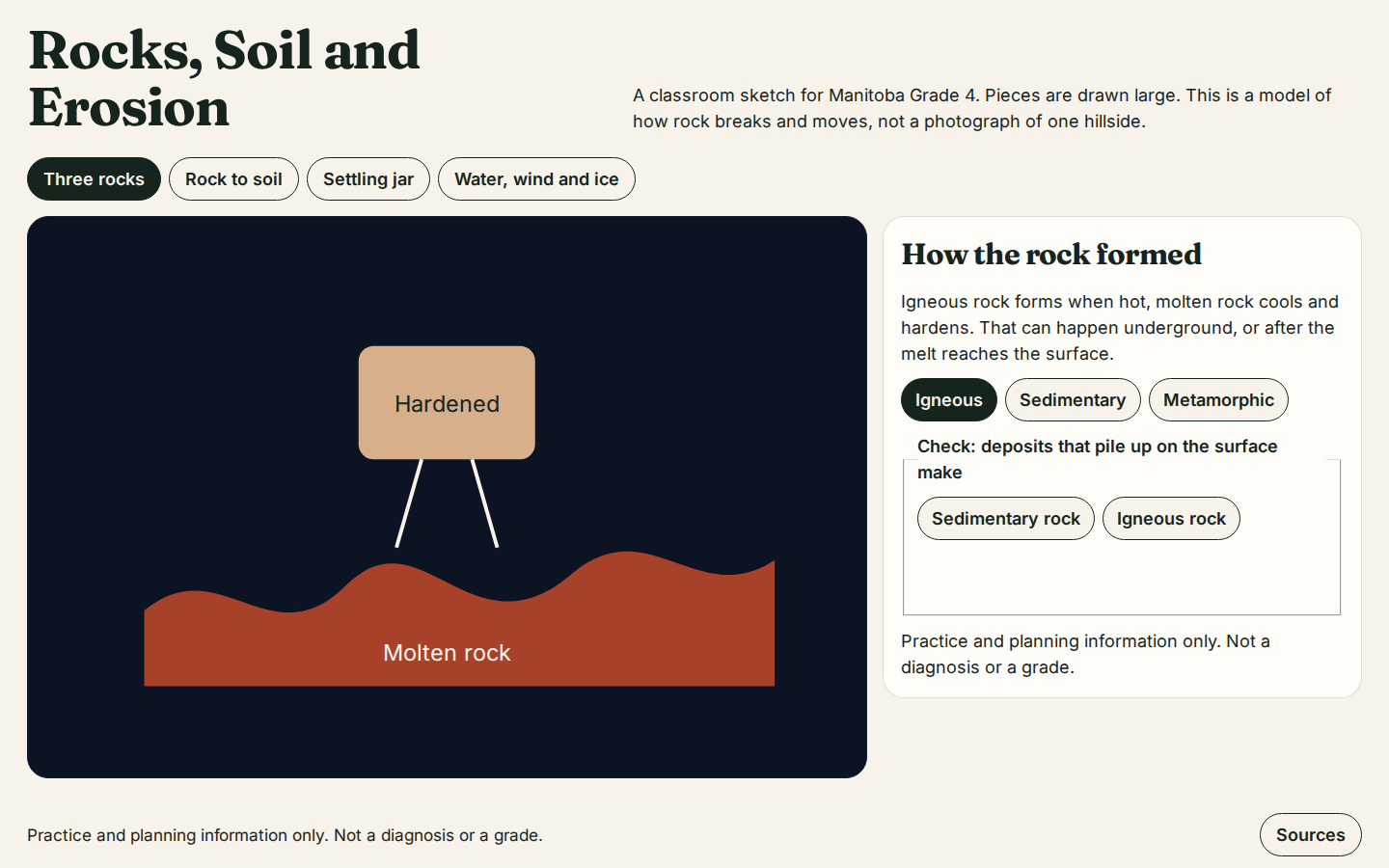
Students sort how three rocks form, follow bedrock down to clay, watch a soil jar settle, and compare a bare slope with a planted one. It is free, runs in the browser, and needs no login or email.
Free · No login · No email · Nothing saved or sent
Milestone Teachers · Manitoba Grade 4 Science · Last reviewed
Open Rocks, Soil and Erosion (free, full screen) · Manitoba classroom science
What it is
- Three ways rock forms. Igneous rock hardens from molten rock. Sedimentary rock forms from deposits. Metamorphic rock changes without melting.
- From bedrock toward clay. Students step from bedrock to boulders, gravel, sand, silt and clay. Weathering breaks rock in place.
- A settling jar. Sand reaches the bottom first. Silt follows. Clay stays cloudy the longest.
- Water, wind, frost and glaciers. Water and wind carry loose soil, and plant cover holds more of it. Frost cracks rock in place. Moving glacial ice carries rock, and roots do not stop that the same way.
- Free. No login, no email, no sign-up.
- Runs in the browser.
- Nothing a student does is saved or sent.
How to use it in class
- Name the rock. Start with igneous. Ask what had to cool. Then show the layers.
- Step the pieces down. Read bedrock, then tap smaller pieces until clay.
- Let the jar sit. Ask which layer students expect on the bottom before the next tap.
- Add the plants. Show the bare slope, then the planted one. Ask which keeps more soil.
Curriculum link
Partial support for selected rocks, soil and erosion outcomes in Manitoba's renewed Grade 4 Science curriculum.
- SCI.4.E.11: Three rock types.
Demonstrate an understanding of the types of rock, rock formation, and geographic location of rock types.
The first activity sorts igneous, sedimentary and metamorphic rock by how each forms. It does not show where those rocks are found. - SCI.4.E.12: Weathering, erosion and soil.
Demonstrate an understanding of weathering and the erosion of rock, and its relation to soil formation.
The piece row, the jar and the slope separate breaking rock in place from carrying it away. Frost stays in place. A glacier carries rock. - SCI.4.E.9: Types of soil.
Demonstrate an understanding of the nature and types of soil.
The jar separates sand, silt and clay, three pieces students meet in sandy, silty and clay soil. - SCI.4.E.10: Fertile soil.
Demonstrate an understanding of the properties of fertile soil.
The clay step says fertile soil also needs air, water, nutrients and living things, not only rock pieces.
Contains information from the Government of Manitoba, licensed under the OpenMB Information and Data Use License (Manitoba.ca/OpenMB). OpenMB licence.
Honest limits
- Rock drawings are not specimens.
- The jar is a sketch of settling order, not a timed soil test.
- The slope does not measure one hillside.
- Partial support for SCI.4.E.9 to E.12. It does not map where rock types are found, and the clay note is not a full account of fertile soil.
- Not a diagnosis or a grade.
Credits
- Science: U.S. Geological Survey, for how the three rocks form and for weathering versus erosion. USDA Natural Resources Conservation Service, for sand settling first in a jar.
- Curriculum: Manitoba Education and Early Childhood Learning, renewed Grade 4 Science, partial support for SCI.4.E.9 to E.12.
- Made by: An independent teaching resource from Milestone Teachers.
Sources
Checked against the sources below on 16 October 2026.
- Manitoba Education and Early Childhood Learning: Science: Grade 4
- U.S. Geological Survey: What are igneous rocks?
- U.S. Geological Survey: What are sedimentary rocks?
- U.S. Geological Survey: What are metamorphic rocks?
- U.S. Geological Survey: Great Sand Dunes: weathering and erosion
- USDA Natural Resources Conservation Service: Elementary Soils Engineering, Chapter 4: jar method
All interactive labs · New curriculum guides
After the lab
More labs for Grade 4
- Energy Sources Lab (Science · Energy in action)
- Habitat Web Lab (Science · Habitats and ecosystems)
- Light and Sound Lab (Science · Light and sound)
- Fraction Repair Lab (Unit fractions)