Free interactive · Manitoba Grade 4 Science · Light and sound
Light and Sound Lab: follow a ray, then a vibration
Students see light leave a lamp in every direction, test a mirror, a dark card, clear plastic and frosted plastic, sort luminous and illuminated objects, and change loudness and pitch. It is free, runs in the browser, and needs no login or email.
Free · No login · No email · Nothing saved or sent
Milestone Teachers · Manitoba Grade 4 Science · Last reviewed
Open Light and Sound Lab (free, full screen) · Manitoba classroom science
What it is
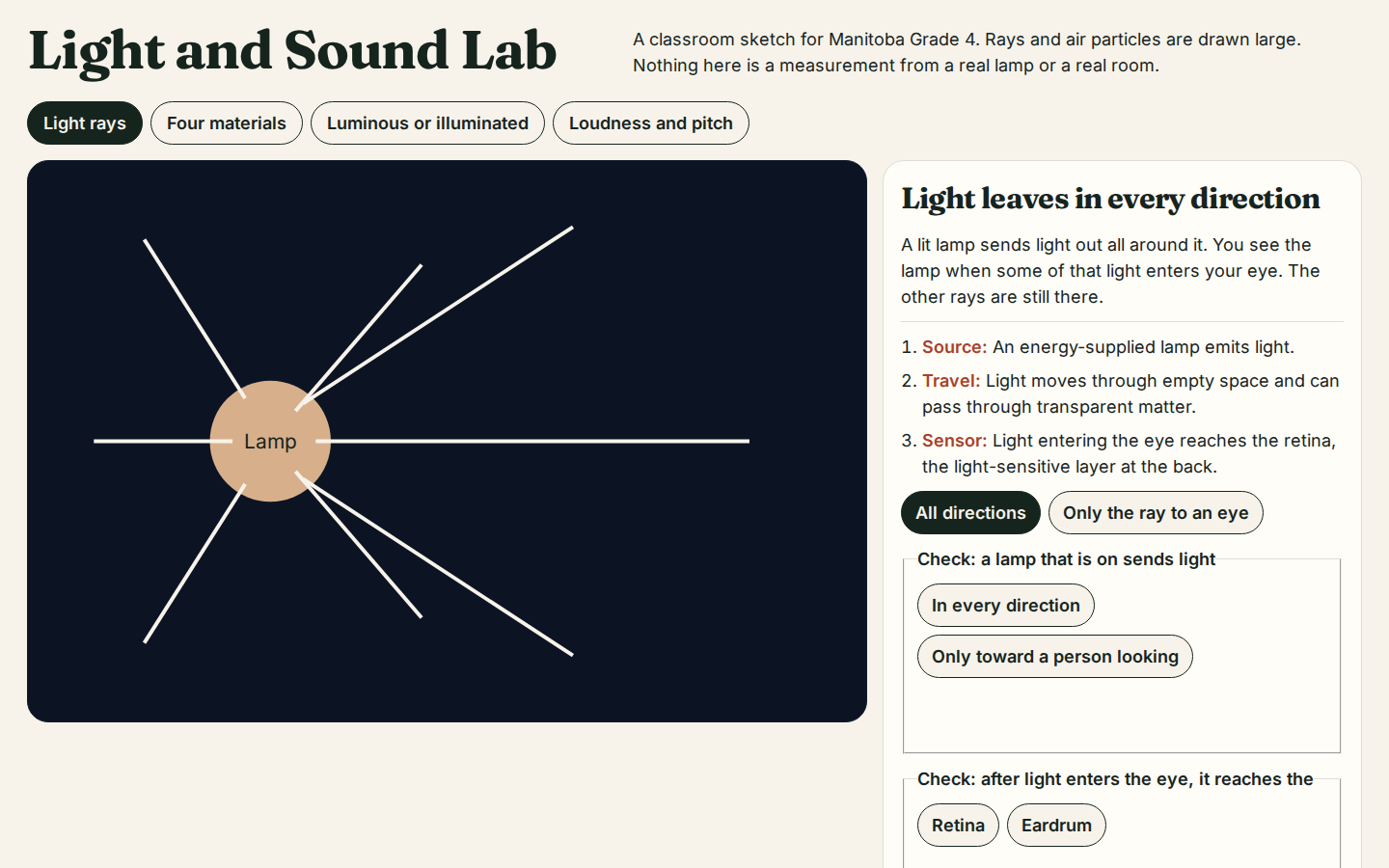
- Rays in every direction. A lamp sends light all around it. A second picture shows only the ray that reaches an eye, and says the other rays are still there.
- Four materials. A mirror reflects at an equal angle. A dark card absorbs most of the beam and still reflects a little. Clear plastic bends the ray and sends it out parallel. Frosted plastic transmits and scatters.
- Luminous or illuminated. Students sort the Sun, a lamp, a flame, a firefly, the Moon, a printed page, a mirror and a book.
- Loudness and pitch. Sliders change the size of a vibration and how often it repeats. Air particles are drawn wiggling in place.
- Free. No login, no email, no sign-up.
- Runs in the browser.
- Nothing a student does is saved or sent.
How to use it in class
- Predict and trace the light. Ask whether a lamp sends light only toward the class. Then trace energy-supplied lamp, travelling light, eye and retina before trying the check.
- Test one material. Pick the mirror, then the dark card. Ask what happened to the beam.
- Sort eight objects. A luminous object makes light. An illuminated object reflects it. A mirror is illuminated.
- Trace sound, then separate loud and high. Name the vibrating source, material and ear drum. Turn loudness up without changing pitch; then raise pitch without making it louder.
Curriculum link
Partial support for the light and sound outcomes of Manitoba's renewed Grade 4 Science curriculum.
- SCI.4.E.1: Light and sound from a source.
Demonstrate the understanding that light and sound are examples of energy that transmits from a source and that can cause effects on objects at a distance.
The source-to-sensor paths start with an energy-supplied lamp or vibrating object and follow light or sound through a material to a sensor. - SCI.4.E.2: Light and sound meet matter.
Demonstrate the understanding that light and sound transmissions can interact in various ways with matter.
A mirror reflects. A dark card absorbs most of the beam and reflects a little. Clear plastic transmits: the ray bends inside the block and leaves parallel to the way it arrived. That picture is a sketch, not a measured refraction experiment. Frosted plastic transmits and scatters. - SCI.4.E.4: Light in every direction.
Demonstrate the understanding that light is emitted in all directions by an energized source, and transmits through empty space or transparent matter to the eyes.
The light path names an energy-supplied lamp, empty space or transparent matter, eye and retina; the second ray picture still says other rays are present. - SCI.4.E.5: Luminous and illuminated.
Demonstrate the understanding that visible objects either emit light or reflect light into the eye.
The sort separates objects that make light from objects that reflect it. - SCI.4.E.3: Sound, loudness and pitch.
Demonstrate the understanding that sound is created by an energized source and is transmitted in all directions as vibrations in air (or other material) to the ears.
The sound path names a vibrating source, travel through material in all directions, ear and ear drum; sliders still separate loudness from pitch.
Contains information from the Government of Manitoba, licensed under the OpenMB Information and Data Use License (Manitoba.ca/OpenMB). OpenMB licence.
Honest limits
- Rays are a drawing, not a photograph of a beam.
- The dark card absorbs most of the light and still reflects a little. A white or light card would reflect more. This is not a claim about every card.
- The clear-plastic ray bends through a parallel-sided block and leaves parallel. It is not a measured refraction experiment.
- The wave is a side-view sketch. Particles do not travel across the screen with the sound.
- The source-to-sensor paths name the required route, but they are not anatomy diagrams, sound playback, or measurements of a real room.
- Partial support for SCI.4.E.1 to E.5. Hearing protection is not in this lab. Teachers still need local observation, investigation, and assessment beyond these models.
- Not a diagnosis or a grade.
Credits
- Science: OpenStax College Physics 2e, by Paul Peter Urone and Roger Hinrichs: light reflection, absorption and transmission, and sound as a vibration in a material. Current web edition: CC BY-NC-SA 4.0. Used as a factual reference only; no OpenStax text or figures are reproduced. Licence: https://creativecommons.org/licenses/by-nc-sa/4.0/.
- Seeing and hearing: National Eye Institute for the retina pathway; National Institute on Deafness and Other Communication Disorders for sound waves reaching the eardrum.
- Curriculum: Manitoba Education and Early Childhood Learning, renewed Grade 4 Science, partial support for SCI.4.E.1 to E.5.
- Made by: An independent teaching resource from Milestone Teachers.
Sources
Checked against the sources below on 16 October 2026.
- Manitoba Education and Early Childhood Learning: Science: Grade 4
- OpenStax: College Physics 2e
- Creative Commons: CC BY-NC-SA 4.0
- National Eye Institute: How the Eyes Work
- National Institute on Deafness and Other Communication Disorders: How Do We Hear?
All interactive labs · New curriculum guides
After the lab
More labs for Grade 4
- Energy Sources Lab (Science · Energy in action)
- Habitat Web Lab (Science · Habitats and ecosystems)
- Rocks, Soil and Erosion (Science · Rocks, soil and erosion)
- Fraction Repair Lab (Unit fractions)