
Same number correct, different next maths lesson
A beginning-of-year maths check can give two pupils the same number correct and still point to different teaching. Ask: "What did this pupil show under these conditions, and what is the smallest next lesson that will clarify it?"
This matters especially with a check of selected Grade 2 skills used as pupils enter Grade 3. It is not a validated placement tool or a verdict on the whole curriculum. Treat the notes below as possible next steps, not diagnoses or readiness bands. The C/P/E/SK/NT labels describe the response:
| Mark | Record it as |
|---|---|
| C | all requested mathematics is correct |
| P | partial or unfinished assessable work, including a correct total without the requested explanation |
| E | an error that reveals a possible idea to test |
| SK | skipped or no usable evidence |
| NT | not yet taught |
Give ordinary access first: read aloud when needed, allow usual tools, and give no adult mathematical hints. Record conditions with the work. Reading support does not mean weaker mathematics. Keep prompted work separate from the initial attempt.
A five-item look, not a label
Five selected items are the value of 7 in 572, expanded form of 406, 83 - 47 and a strategy, 96 - 42 and a strategy, and 8 + 7 with a make-ten explanation. The expected ideas are 70, 400 + 6, 36, 54, and 15 with a make-ten connection.
The two response patterns below are fictional. They are not records of real pupils. Both were completed under the same access conditions, without adult mathematical hints.
Value of 7 in 572
Pattern A
70 (C)
Pattern B
7 (E)
Teacher opening: Does the pupil connect a digit to its place value?
Expanded form of 406
Pattern A
400 + 6 (C)
Pattern B
400 + 60 (E)
Teacher opening: Is the zero tens place being attended to?
83 - 47
Pattern A
44 (E): "8 - 4 = 4; 7 - 3 = 4"
Pattern B
36 (C): 47 -> 50 (+3), 50 -> 80 (+30), 80 -> 83 (+3); total 36
Teacher opening: Can the pupil preserve value while subtracting?
96 - 42
Pattern A
54 (C): 9 tens - 4 tens; 6 ones - 2 ones
Pattern B
54 (C): 90 - 40 = 50 and 6 - 2 = 4
Teacher opening: Does the strategy fit the quantities?
8 + 7
Pattern A
15 (P): answer only
Pattern B
15 (C): 8 + 2 + 5
Teacher opening: Is the make-ten relationship available to the pupil?
Both patterns have three fully correct responses. Pattern A also has a P, which is evidence rather than zero; Pattern B's place-value errors sit beside valid, explained subtraction. Neither pattern makes a fixed ability group.
Pattern A: teach one exchange, then listen again
Start with 83 - 47. Build 83 as 8 tens and 3 ones, then exchange one ten for 10 ones: 7 tens and 13 ones. Now 13 - 7 leaves 6 ones, and 7 tens - 4 tens leaves 3 tens: 36. Ask, "What stayed the same when we exchanged one ten?"
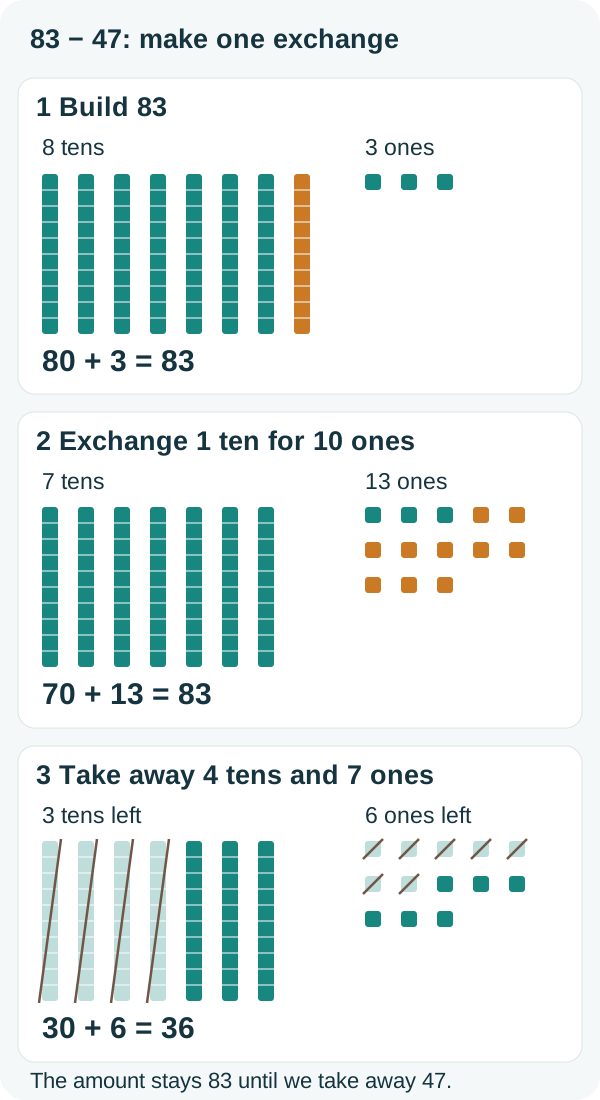
Then use 72 - 38 = 34 as a parallel probe only if the pupil has not already seen it. If it has been seen, select an unseen equivalent that requires one exchange. Accept a valid counting-up explanation as readily as a regrouping representation. A pupil does not need to use the column algorithm to show sound subtraction thinking.
Before reteaching 8 + 7, ask orally, "How could you make ten from 8 and 7?" If needed, use counters or a ten frame to move 2 from 7 to 8 and name 10 + 5.
Pattern B: make the zero visible
Pattern B already gives a useful subtraction strategy. Keep it visible. The next lesson is place value: put 405 and 450 on a hundreds-tens-ones chart, match the four hundreds, then compare 0 tens with 5 tens. Link the numerals to 400 + 5 and 400 + 50.
For a quick fresh check, ask the pupil to write 607 in expanded form and compare 607 and 670. Look for 600 + 7 (or 600 + 0 + 7) and 607 < 670, with an explanation that zero tens is less than seven tens.
These steps use explicit mathematical language, representations, and a brief check after teaching. The Institute of Education Sciences practice guide supports those general practices; it does not endorse this check or prescribe pupil labels.
Preserve the initial attempt and record the date and conditions for follow-up. One small, well-matched lesson followed by a fresh look tells you more than a score alone.
Read the Grade 3 beginning-of-year math assessment guide if you want this grade-level set of prompts and teaching follow-ups. If you are coordinating checks across grades, browse the math resources in the Library; each resource should still be used as a starting point for instruction, not a pupil label.